


Starting a podcast sounds simple until you actually try to do it. You need somewhere to upload your episodes, an RSS feed to distribute your show, analytics to understand your listeners, and ideally some tools to help you grow and make money.
That’s where podcast hosting platforms come in.
Podbean is one of the better-known podcast hosting services, and it has been around for years. But the podcasting world has changed a lot. There are now plenty of alternatives, including Buzzsprout, Libsyn, Castos, Transistor, RSS.com, and Spotify for Creators.
So is Podbean still worth using in 2026?
After looking at its current features, pricing, analytics, monetization tools, AI features, and overall ease of use, I’d say yes — especially if you want more than basic podcast hosting.
Podbean is not necessarily the simplest podcast host available. However, it packs a lot into one platform. You can host audio and video, distribute your podcast, create a website, analyze your audience, monetize your show, and even use AI tools to improve your production workflow.
Here’s my full Podbean review.
What Is Podbean?
Podbean is a podcast hosting and publishing platform designed to help creators manage their podcasts from one place.
At its most basic level, Podbean does what you’d expect from a podcast host.
You upload an episode, Podbean hosts the file, creates and maintains your RSS feed, and helps distribute your podcast to major listening platforms.
But that’s only part of what the platform offers.
Podbean also provides podcast websites, embedded players, analytics, monetization tools, live streaming, video podcasting, subscriptions, and AI-powered features. Its current plans also include one-click distribution to major directories.
That’s what makes Podbean interesting. It’s not trying to be just a place to store your MP3 files. It’s trying to be a complete podcasting platform.
Podbean Pricing
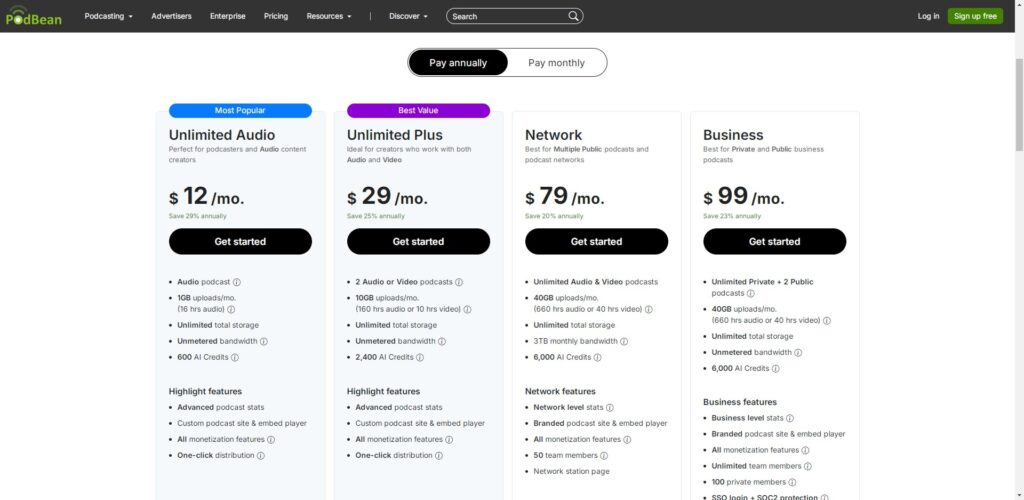
Let’s talk about the part most people want to know about first: how much does Podbean cost?
Podbean currently has a free option, along with several paid plans.
Its Unlimited Audio plan costs $12 per month when billed annually, or $17 per month when billed monthly.
This plan is designed for audio podcasts and includes 1GB of new uploads per month, which Podbean estimates at around 16 hours of audio. It also includes unlimited total storage, unmetered bandwidth, advanced podcast statistics, a customizable podcast website, an embeddable player, monetization features, and one-click distribution.
The next major option is Unlimited Plus. It costs $29 per month when billed annually, or $39 per month when billed monthly. This plan supports up to two audio or video podcasts and provides 10GB of uploads per month. Podbean estimates that at around 160 hours of audio or 10 hours of video.
For podcast networks, Podbean has a Network plan that costs $79 per month when billed annually or $99 per month when billed monthly. It supports unlimited public podcasts, 40GB of uploads per month, unlimited storage, 3TB of monthly bandwidth, and up to 50 team members.
Podbean also offers business and enterprise plans for organizations that need private podcasts, additional security, team management, SSO, and other business features.
The good thing about this pricing structure is that there is a plan for almost every type of podcast.
The downside is that the higher-level plans can become expensive if you’re just an individual creator.
Is Podbean Easy to Use?
This is probably where Podbean isn’t quite as impressive as some of its competitors.
Don’t get me wrong. Podbean isn’t difficult to use.
Uploading an episode is straightforward, and the dashboard gives you access to the main tools you need.
But Podbean does a lot.
There are analytics.
Monetization.
AI tools.
Websites.
Live streaming.
Video.
Subscriptions.
Apps.
Distribution.
When you have that many features, the interface can naturally feel more complicated than a platform designed around one simple task.
For beginners, this can be a little overwhelming at first.
But once you understand where everything is, the platform becomes much easier to navigate.
I’d give Podbean around 4 out of 5 for ease of use.
If absolute simplicity is your number-one priority, I’d probably look at Buzzsprout.
If you want more features and don’t mind spending some time learning the platform, Podbean is a good choice.
Podcast Hosting and RSS Feed
This is the foundation of any podcast hosting service. If the hosting isn’t reliable, everything else becomes irrelevant.
Podbean gives each podcast its own RSS feed, which you can use to distribute your show to podcast directories. Its platform supports distribution to services including Apple Podcasts, Spotify, Amazon Music, iHeartRadio, and others.
Podbean also allows you to import an existing podcast from another hosting provider through its RSS feed.That’s useful if you’re moving your podcast from another platform. You don’t need to start from scratch. You can bring your existing show over and continue publishing from Podbean. For most podcasters, this is exactly what they need.
Storage and Bandwidth
One of Podbean’s biggest selling points is its approach to storage and bandwidth. Paid plans offer unlimited total storage, while bandwidth is unmetered on the main creator plans. This is important because podcast downloads can grow significantly over time.
Imagine you publish an episode that suddenly goes viral. Thousands or even millions of people could download it. You don’t want to suddenly discover that you’ve exceeded a bandwidth allowance and have to pay a huge overage fee.
Podbean’s current paid plans are designed to avoid that kind of problem. There is still a monthly upload allowance, however.
For example, the Unlimited Audio plan provides 1GB of new uploads per month. So “unlimited” doesn’t mean you can upload an unlimited amount of new material every month. It means your total stored content isn’t capped on those plans. That’s an important distinction.
Podbean Analytics
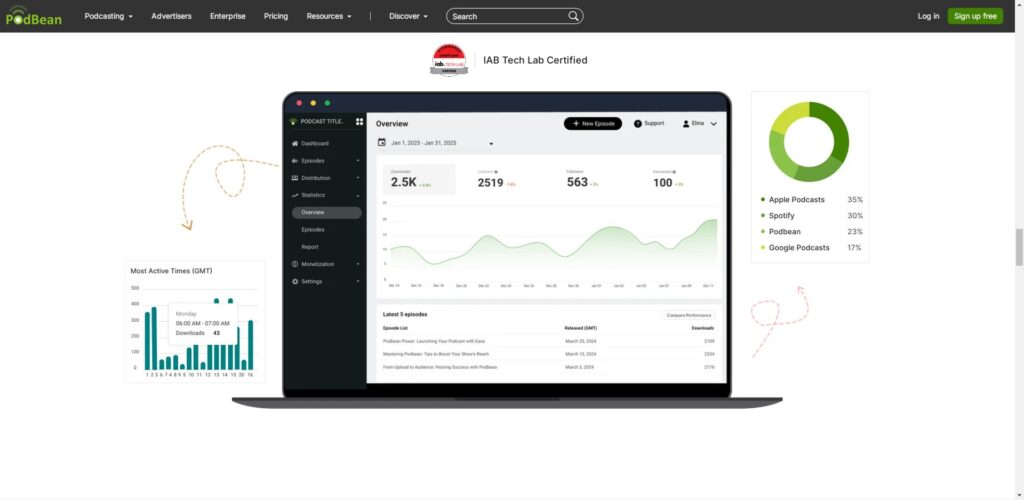
Analytics are one of Podbean’s stronger features. The platform provides advanced podcast statistics that can show information about your listeners, including locations, devices, traffic sources, and trends.
Podbean also offers episode comparison and engagement information. This is useful because raw download numbers don’t tell you everything.
Suppose one episode gets 10,000 downloads and another gets 7,000.
At first glance, the first episode looks like the winner.
But what if the second episode has better listener retention?
Or more relistens?
Or better engagement?
That’s the kind of information that can help you make smarter content decisions. For a beginner, the analytics may be more information than you need.
Podbean Monetization
This is one of Podbean’s biggest strengths. The platform offers several ways to make money from a podcast.
There is an Ads Marketplace, which allows creators to find advertising opportunities.
Podbean also supports dynamic ad insertion, allowing ads or other content to be inserted into podcast episodes. It also supports Apple Podcasts subscriptions.
And Podbean has a premium podcasting system that lets creators sell exclusive content directly to listeners.
According to Podbean, creators can create premium content and sell individual episodes, series, seasons, courses, or other packages. This is a big advantage for creators who want to turn their podcast into a business.
For example, imagine you have a free weekly podcast about personal finance. You could keep the main show free and offer a premium feed containing bonus episodes, detailed interviews, or members-only content. You don’t have to build the entire system yourself. Podbean provides tools to manage it.
Podbean AI
AI has become a big part of podcasting, and Podbean has started adding AI directly into its platform.
Its current AI system includes AI Audio Optimization, AI Content Assistant, and AI Podcast Creator.
The audio optimization tools can help with things such as noise reduction, leveling, filler-word removal, silence removal, filtering, and automatic EQ.
The Content Assistant can help generate podcast titles, show notes, chapter markers, and enhanced transcripts.
There’s also an AI Podcast Creator that can turn text, files, blogs, or ideas into podcast episodes.
This is interesting, particularly for creators who don’t want to spend hours on repetitive post-production tasks. Of course, I’d still recommend listening to the final result yourself. AI can save time, but it shouldn’t replace human judgment. Still, having these tools built directly into your hosting platform is convenient.
Video Podcasting
Video podcasts have become increasingly important. Many people now discover podcasts through YouTube rather than traditional podcast apps.
Podbean supports video podcasting on its Unlimited Plus plan and higher-level plans.
The Unlimited Plus plan supports two audio or video podcasts and up to 10GB of uploads per month, which Podbean estimates at up to 10 hours of video.
This makes Podbean more versatile than a platform that focuses only on audio.
You can manage audio and video content from the same general workflow.
For creators who are already publishing on YouTube, Podbean also offers tools that can help turn existing video content into podcast episodes.
If your long-term plan is to build both an audio and video podcast, Podbean is worth considering.
Podcast Website
Another nice feature is Podbean’s built-in podcast website.
Paid plans include a customizable podcast website and embeddable player. Podbean also allows creators to use their own domain on supported plans. This is useful when you’re starting out.
You don’t necessarily need to buy hosting and build a WordPress website just to have somewhere for listeners to find your episodes.
Podbean gives you a ready-made home for your podcast.
The customization isn’t going to replace a fully developed WordPress website for every business, but it’s more than enough for many independent creators.
Podbean Mobile App
Podbean also has mobile apps for iPhone and Android.
This means you can manage parts of your podcast workflow from your phone, track statistics, publish content, and interact with listeners without always sitting in front of a computer.
That’s particularly useful if you’re someone who records interviews or creates content while traveling. It’s not a feature everyone will use regularly, but it’s nice to have.
Podbean Pros
The biggest advantage of Podbean is how much it puts into one platform. You get hosting, distribution, analytics, monetization, websites, video podcasting, mobile apps, and AI tools.
The paid plans also offer unlimited total storage and unmetered bandwidth on the main creator plans.
Its monetization options are another major strength. And if you eventually build a podcast network, Podbean has plans specifically designed for multiple shows and teams.
Podbean Cons
The biggest downside is that the platform can feel like a lot for a complete beginner.
If all you want to do is upload a weekly audio podcast, you may never use half of the features you’re paying for. The upload limits are another thing to watch.
The Unlimited Audio plan provides 1GB of new uploads per month, so very active podcasters may need a higher plan.
And while Podbean has a free option, serious creators will probably want a paid plan for access to the more useful features.
Podbean vs. Buzzsprout
This is probably one of the comparisons you’ll see most often. Buzzsprout is easier. Podbean offers more. That’s really the simplest way to explain it.
Buzzsprout is excellent for independent creators who want a clean publishing experience.
Podbean is better suited to creators who want more tools under one roof.
I’d choose Buzzsprout for a simple weekly podcast.
I’d choose Podbean for a podcast that I expect to monetize, expand into video, or eventually turn into a larger media project.
Is Podbean Worth It?
After looking at everything Podbean offers, I think it is. But there’s an important condition. You need to actually use the features you’re paying for.
If you’re publishing a 20-minute podcast once a week and don’t care about monetization, AI, video, or advanced analytics, you can probably find a simpler and cheaper solution.
But if you’re serious about podcasting, Podbean becomes much more attractive.
The combination of hosting, analytics, monetization, distribution, video, AI, and websites makes it a very complete platform.
Final Thoughts: Podbean Review
So, would I recommend Podbean? Yes. Its biggest strength is versatility. You don’t have to use five different services to run your podcast. Podbean gives you most of the important tools in one place.
The Unlimited Audio plan at $12 per month when billed annually is particularly appealing for creators who mainly publish audio, while the $29-per-month annual Unlimited Plus plan makes more sense for creators who want audio and video.
The analytics are strong. The monetization options are impressive. The video support is useful. The new AI features can save time. And the built-in website means you can get started without building an entire website from scratch.
The main reason I wouldn’t recommend Podbean to everyone is simplicity. There are easier podcast hosts. But if you’re willing to spend a little time learning the platform, the number of tools you get in return is impressive.
Overall, Podbean is still a strong choice in 2026.
It may not be the perfect podcast host for everyone, but for creators who want room to grow, it’s one of the more complete options available. And that’s probably the biggest reason to consider it. You might start with a simple weekly podcast today.
A year from now, you could have sponsors, premium episodes, video content, thousands of listeners, and a team helping you run the show.