


Recording good audio used to mean dealing with cables. You connected a microphone to an audio interface. The interface connected to your computer. If you wanted to move around while recording, things became even more complicated.
Wireless microphones have changed that.
Today, tiny microphones can clip onto your shirt and send your voice wirelessly to a phone, camera, or computer. Some models can even connect directly to compatible devices through Bluetooth.
That’s great for TikTok, YouTube, interviews, vlogging, online courses, livestreams, and mobile podcasting.
But there’s an important detail. “Bluetooth microphone” and “wireless microphone” aren’t always the same thing.
Many of the best professional wireless microphones use a dedicated wireless connection between a transmitter and receiver rather than relying entirely on ordinary Bluetooth audio.
What is the Best Bluetooth Microphones?
here are some of the best Bluetooth and wireless microphones for creators.
1. DJI Mic 3 – Best Overall Bluetooth/Wireless Microphone
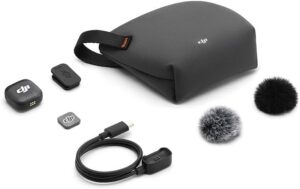
The DJI Mic 3 is my overall choice for serious creators who want a compact wireless system with professional features.
The transmitters are tiny. Each one weighs around 16 grams with its magnet, making it easy to clip onto clothing without pulling down your shirt.
But the small size hides an impressive feature set. The system supports 32-bit float internal recording, adaptive gain control, two levels of noise cancellation, timecode, and multiple voice tone presets.
The transmitter also supports Bluetooth 5.4. For normal professional recording, the system can use its dedicated wireless connection with the receiver, giving you much greater flexibility with cameras and other equipment.
One of the biggest advantages is internal recording. Imagine you’re filming an interview and something interferes with the wireless signal. If your microphone is also recording internally, you have a backup. That’s extremely valuable on professional shoots where you can’t simply ask someone to repeat an entire interview.
The DJI Mic 3 can also work with multiple transmitters and receivers, making it more expandable than basic two-person systems.
For serious YouTubers, filmmakers, interviewers, and mobile creators, it’s one of the most capable choices.
2. RØDE Wireless Micro – Best for Smartphones
Not everyone needs timecode and complex multi-channel recording. Sometimes you just want better audio from your phone.
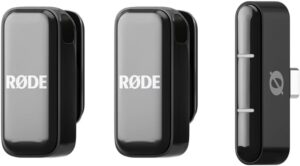
That’s where the RØDE Wireless Micro makes sense. The system is designed around smartphone content creation.
You get two tiny clip-on transmitters with built-in microphones and a receiver that connects directly to your smartphone.
Depending on the version, you can get a USB-C or Lightning receiver. The simplicity is the biggest attraction. Connect the receiver. Clip a transmitter to your shirt. Start recording.
RØDE’s GainAssist technology automatically manages levels, reducing the amount of technical setup you need to think about. The charging case also extends the system’s total battery life to as much as 21 hours.
For someone creating TikTok videos, Instagram Reels, YouTube Shorts, interviews, or talking-head videos on a smartphone, that’s incredibly convenient. The limitation is also obvious. This system is primarily designed around smartphones.
If you regularly switch between a mirrorless camera and phone, you may prefer a more flexible system.
3. DJI Mic Mini – Best Compact Wireless Microphone
Maybe you like DJI’s wireless microphone ecosystem but don’t need all the advanced capabilities of the Mic 3. The DJI Mic Mini is the more straightforward option. It’s designed to be small, lightweight, and easy to carry. That’s important for travel creators.
The Mic Mini is especially attractive for vloggers and solo creators who want something they can leave in their bag all the time.
It can work with phones and cameras, and it integrates particularly well with compatible DJI devices.
For everyday content creation, the simpler design may actually be an advantage. You don’t need every professional feature.
You need a microphone that takes a few seconds to set up and sounds much better than the microphone built into your phone or camera.
4. Hollyland LARK M2 – Best Tiny Lavalier-Style System
The Hollyland LARK M2 is another extremely compact wireless microphone system. The tiny transmitter is the main attraction. Large wireless transmitters can look distracting when clipped onto someone’s clothing.
That’s particularly noticeable during interviews. A smaller transmitter creates a cleaner appearance and can be easier to hide.
The LARK M2 is designed for cameras, smartphones, and content-creation workflows, depending on the version or kit you choose. It also includes environmental noise cancellation. That can be useful when you’re recording outdoors or in busy environments. But don’t expect noise cancellation to perform miracles.
A microphone can’t completely erase traffic, wind, crowds, and other sounds while perfectly preserving your voice. Microphone placement still matters. Keep the transmitter reasonably close to your mouth and use proper wind protection outdoors.
5. Sennheiser Profile Wireless – Best for Flexible Recording
Sennheiser’s Profile Wireless takes an interesting approach to portable microphone systems.
The system is designed to give creators several recording options without carrying a large collection of separate accessories.
You can use the transmitters as clip-on microphones for interviews and video. The charging bar can also become part of a handheld microphone setup. That’s useful if you create different types of content.
Maybe you’re filming an interview in the morning. Later, you’re recording a quick presenter segment.
Then you’re capturing a street interview where holding a microphone makes more sense than attaching one to someone’s clothing.
A flexible system reduces the amount of equipment you need to carry.
Sennheiser also has decades of experience building professional microphones, which makes the Profile Wireless particularly interesting for creators who prioritize audio.
6. Shure MoveMic 88+ – Best for Versatile Mobile Recording
The Shure MoveMic 88+ takes a different approach from typical wireless lavalier microphones. Instead of focusing entirely on a tiny clip-on transmitter, it’s designed to give mobile creators more control over how sound is captured.
That can make it useful for creators recording more than speech. A standard clip-on wireless microphone is great when one person is talking.
Shure has a long history in professional audio, and its mobile microphone products are aimed at bringing some of that control to creators working with phones and portable setups.
If you’re primarily recording one person speaking, a simpler clip-on system may make more sense.
If you want to experiment with different types of recordings, the MoveMic approach becomes more interesting.
7. RØDE Wireless Micro – Best for Beginners
The RØDE Wireless Micro gets another recommendation because it’s one of the easiest systems for a beginner to understand.
For someone filming their first videos, all of that can become a distraction. The Wireless Micro simplifies the process.
Its transmitters pair automatically, the receiver plugs directly into your smartphone, and GainAssist helps manage the recording level. That’s exactly what a beginner needs.
You can concentrate on framing the shot, lighting, and what you’re actually saying instead of constantly checking audio settings.
Later, when your productions become more complicated, you can move to a system with internal recording, timecode, and more manual controls.
What Is a Bluetooth Microphone?
A Bluetooth microphone is a microphone capable of transmitting audio wirelessly using Bluetooth technology.
In theory, this sounds simple. Pair the microphone with your phone. Record. In practice, professional wireless microphone systems are more complicated.
Bluetooth is designed for convenience and broad compatibility, but wireless audio can involve compression, latency, connection limitations, and device-specific restrictions.
That’s why many professional wireless microphone systems use their own transmitter-to-receiver connection.
The transmitter stays near the person speaking. The receiver connects to the phone or camera. Audio travels wirelessly between them.
Some modern systems also include Bluetooth for direct connections to compatible devices.
So when shopping for the “best Bluetooth microphone,” don’t automatically reject a product because its primary professional connection uses something other than Bluetooth.
A dedicated wireless link may actually be preferable.
Best Bluetooth Microphone for iPhone
For iPhone creators, the RØDE Wireless Micro is one of the easiest options. Choose the appropriate version for your iPhone’s connector.
Newer iPhones use USB-C, while older models may require Lightning-compatible equipment. The direct receiver design keeps the setup simple.
For more advanced video production, the DJI Mic family gives you additional options and features.
Before buying any microphone, check the exact connection required by your specific iPhone. Don’t assume every “iPhone microphone” works with every generation.
Best Bluetooth Microphone for Android
Again, the RØDE Wireless Micro is an excellent choice if your Android phone supports the appropriate USB-C connection. The DJI Mic Mini is another strong option for creators who may also use cameras.
Android compatibility can vary between devices and recording applications, so check your phone before buying.
If you’re using an unusual or older Android model, confirm that it supports external USB audio.
Which Bluetooth Microphone Should You Buy?
For serious creators, my overall recommendation is the DJI Mic 3.
It combines a compact design with advanced features such as 32-bit float internal recording, adaptive gain control, noise cancellation, timecode, and Bluetooth 5.4 support.
For smartphone creators who value simplicity, choose the RØDE Wireless Micro. For a smaller, simpler DJI setup, consider the DJI Mic Mini.
If discreet transmitters are important, the Hollyland LARK M2 is worth considering.
And if you want a more flexible portable system for different recording styles, look at the Sennheiser Profile Wireless.
Final Thoughts
The best Bluetooth microphone isn’t necessarily the microphone that relies entirely on Bluetooth. That’s the most important thing to understand.
Bluetooth is convenient, but professional wireless audio often works better through a dedicated transmitter and receiver.
For TikTok, Reels, YouTube Shorts, and simple smartphone videos, convenience may be your biggest priority.
That’s where something like the RØDE Wireless Micro shines.
For professional interviews, YouTube productions, and paid video work, I’d choose something with more protection against mistakes.
That’s why the DJI Mic 3 is my best overall Bluetooth/wireless microphone.
It gives you Bluetooth support while also providing a much more complete professional wireless recording system.
Whatever you choose, put the microphone close to the person speaking.
A $100 microphone six inches from your mouth can easily produce more useful audio than an expensive microphone sitting across the room.