


A good studio microphone can completely change the quality of your recordings. Whether you’re recording vocals, acoustic guitar, voiceovers, drums, podcasts, or other instruments, the microphone is one of the first pieces of equipment in your recording chain. It captures the original performance, so getting that first step right matters.
The good news is that you don’t need a professional recording studio or a microphone that costs thousands of dollars. There are excellent studio microphones available at almost every price.
For most home studios, I recommend starting with a versatile large-diaphragm condenser microphone. These microphones can capture detailed vocals and instruments while handling many different recording jobs.
The RØDE NT1 Signature Series is my favorite overall choice because it combines extremely low self-noise, high SPL handling, and a versatile sound at a reasonable price. More advanced studios may prefer something like the Neumann TLM 103, while podcasters and vocalists working in untreated rooms should also consider a dynamic microphone such as the Shure SM7B.
What is the Best Studio Mics?
Here are some of the best studio mics to consider.
1. RØDE NT1 Signature Series – Best Studio Mic Overall
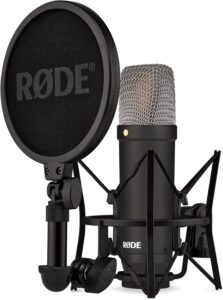
The RØDE NT1 Signature Series is one of the easiest microphones to recommend for a home studio.
It’s a large-diaphragm cardioid condenser microphone designed to work with many different sound sources. You can record singing. You can record acoustic guitar. You can use it for piano, percussion, electric guitar, voiceovers, and even podcasting.
The NT1 Signature uses a 1-inch true condenser capsule and has a frequency range of 20 Hz to 20 kHz.
One of its biggest advantages is extremely low self-noise. RØDE rates it at only 4 dBA. That makes it particularly useful when you’re recording quiet sources where microphone noise can become noticeable.
It can handle loud sounds too, with a maximum SPL rating of 142 dB. The package also includes a studio shock mount, pop filter, and XLR cable. You will need an audio interface or mixer capable of supplying 48V phantom power.
2. Neumann TLM 103 – Best Premium Studio Microphone
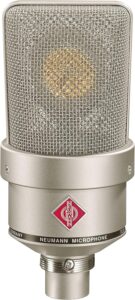
If you’re ready to move into professional studio territory, the Neumann TLM 103 is worth considering.
Neumann microphones have a long history in professional recording studios, and the TLM 103 is designed to bring some of that heritage into project and professional studios. It’s a large-diaphragm cardioid condenser microphone.
Its capsule design is derived from Neumann’s legendary U 87 A, although the TLM 103 has its own sound and design.
Neumann gives the microphone a 20 Hz to 20 kHz frequency range. It also has an extremely low rated self-noise of 7 dBA and can handle up to 138 dB SPL. The TLM 103 has a presence boost that helps add definition to recordings.
It’s particularly suitable for vocals and speech, but Neumann also recommends it for applications including drums, guitar amplifiers, piano, cello, and double bass.
The obvious disadvantage is price. Most beginners don’t need to spend this much.
3. Audio-Technica AT4040 – Best Midrange Studio Mic
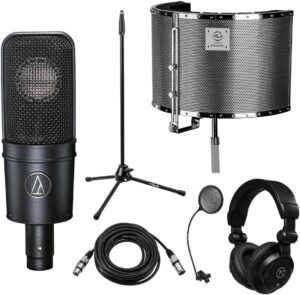
The Audio-Technica AT4040 sits in a useful position between inexpensive beginner condensers and expensive professional studio microphones.
It’s an externally polarized cardioid condenser microphone with a 20 Hz to 20 kHz frequency response.
Audio-Technica rates the microphone for a maximum input level of 145 dB SPL. Engage its 10 dB pad and that figure increases to 155 dB SPL. There’s also an 80 Hz low-frequency roll-off switch. These features make the AT4040 surprisingly versatile. You aren’t limited to recording vocals.
You can experiment with acoustic instruments, amplifiers, percussion, and louder sources.
The microphone requires 48V phantom power, so you’ll need a compatible audio interface or microphone preamp.
If you’ve outgrown an entry-level condenser but aren’t ready to spend Neumann money, the AT4040 is an excellent middle ground.
4. Shure SM7B – Best Studio Mic for Vocals and Speech
Not every studio microphone needs to be a condenser. The Shure SM7B is a dynamic cardioid microphone that has become incredibly popular for vocals, voiceovers, broadcasting, and podcasting.
One reason is its close-mic performance. You can position the SM7B relatively close to your mouth and get a smooth, focused vocal sound.
This can be particularly helpful if your recording space isn’t perfectly treated.
Shure includes internal air-suspension shock isolation to reduce mechanical noise and a built-in pop filter to control breath and plosive sounds. The microphone also provides bass roll-off and presence-boost controls. The SM7B isn’t limited to speech.
Shure recommends it for professional studio recordings and notes that it can also be useful for close-miking instruments. The main issue is gain.
The SM7B has a relatively low output, so pairing it with a microphone preamp or interface capable of providing plenty of clean gain is important.
5. RØDE NT1 5th Generation – Best USB and XLR Studio Mic
The RØDE NT1 5th Generation is a great choice if you’re building your first studio and don’t yet own an audio interface. It gives you both USB and XLR.
Connect it directly to a computer through USB and the microphone acts as an all-in-one recording solution.
If you later buy an audio interface, you can switch to XLR. That’s extremely convenient.
The microphone uses the same general large-diaphragm condenser approach that makes the NT1 family so versatile.
RØDE specifies a 20 Hz to 20 kHz frequency range, 4 dBA self-noise, and 142 dB maximum SPL. The digital side is particularly interesting.
Through USB, the NT1 5th Generation supports 32-bit float recording and analog-to-digital conversion at up to 192 kHz. It also offers onboard DSP processing. For someone who wants studio-quality flexibility without immediately building an XLR setup, it’s an excellent option.
6. Shure SM57 – Best Studio Mic for Instruments
Walk into enough recording studios and you’ll eventually see a Shure SM57. Probably several of them.
It’s a simple dynamic microphone that has become a standard tool for recording instruments. Guitar amplifiers and snare drums are two classic applications.
One advantage is durability. You don’t have to treat an SM57 like a delicate high-end condenser microphone. It’s also relatively compact, making it easy to position close to drums and amplifiers.
And because it’s dynamic, it doesn’t require phantom power. The SM57 probably wouldn’t be my first purchase if I only wanted to record detailed solo vocals.
But if you’re building a studio where you’ll regularly record bands, drums, guitars, and amplifiers, it’s one of the most useful microphones you can own.
7. RØDE NTK – Best Tube Studio Microphone
If you’re looking for something with a different character, consider a tube microphone such as the RØDE NTK. The NTK is a large-diaphragm valve condenser microphone.
It uses a 1-inch gold-sputtered condenser capsule along with a hand-selected twin-triode 6922 valve.
RØDE describes the result as a rich and warm sound designed for demanding studio applications. That’s why tube microphones can be interesting. Not every studio recording needs to be perfectly neutral.
Sometimes you want a microphone that adds a particular character to vocals or instruments.
The NTK can be used for vocals, guitar, piano, drums, and other studio sources. It’s more specialized than the NT1, so I wouldn’t necessarily recommend it as everyone’s first microphone.
But once you already have a good general-purpose condenser, adding a tube microphone can give you another tonal option.
Final Thoughts
For most home studios, the RØDE NT1 Signature Series is my best overall studio mic.
Its large-diaphragm cardioid condenser design works with vocals and a wide range of instruments. RØDE specifies a 20 Hz–20 kHz frequency range, exceptionally low 4 dBA self-noise, and 142 dB maximum SPL.
For a premium condenser, choose the Neumann TLM 103. For a midrange studio setup, consider the Audio-Technica AT4040.
For close vocals, podcasts, and voiceovers, the Shure SM7B remains an excellent dynamic option.
For beginners who want USB and XLR, choose the RØDE NT1 5th Generation. And for recording guitar amps and drums, every studio can find a use for a Shure SM57.