


Audio-Technica makes microphones for almost every type of creator. You can find inexpensive condensers for a first home studio, dynamic microphones designed specifically for podcasting, USB microphones that plug directly into a computer, and professional studio condensers that cost considerably more.
That variety is useful. It also makes choosing one difficult.
A podcaster recording in a bedroom doesn’t necessarily need the same microphone as a singer recording vocals in a treated studio. Someone starting out may want USB simplicity, while an experienced producer may prefer XLR and a separate audio interface.
For most home-studio users, the Audio-Technica AT2035 offers one of the best combinations of sound quality, low noise, useful controls, and price. But there are several other Audio-Technica microphones worth considering.
What is the Best Audio-Technica Microphones?
Here are the best options.
1. Audio-Technica AT2035 – Best Overall Audio-Technica Microphone
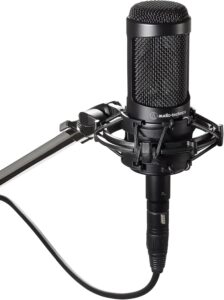
The AT2035 is my overall choice for someone who wants a serious studio microphone without immediately moving into expensive professional gear. It’s a large-diaphragm condenser microphone with a cardioid polar pattern.
Audio-Technica rates it with a frequency response of 20 Hz to 20 kHz and a self-noise level of 12 dB SPL. It also includes an 80 Hz high-pass filter and a switchable -10 dB pad. Those two switches make the AT2035 surprisingly versatile.
The high-pass filter can help reduce low-frequency noise from air conditioning, traffic, desk vibrations, or excessive proximity effect.
The -10 dB pad lets the microphone handle louder sound sources. Audio-Technica rates it for up to 158 dB SPL with the pad engaged. That means you aren’t limited to quiet vocals.
You can record acoustic instruments, guitar cabinets, percussion, and other sources too.
Audio-Technica also includes a shock mount, which saves you from immediately buying another accessory.
The AT2035 does require phantom power and an XLR audio interface, so it isn’t the simplest option for a complete beginner. But for a proper home studio, it’s an excellent all-rounder.
Best for: Vocals, instruments, voiceovers, and home studios.
2. Audio-Technica AT2020 – Best Budget Studio Microphone
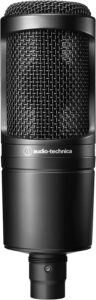
Few affordable studio microphones are as recognizable as the AT2020. It’s been one of Audio-Technica’s most popular entry-level condensers for years.
The AT2020 is a cardioid condenser microphone with a 20 Hz to 20 kHz frequency response and maximum input level of 144 dB SPL. It requires 48V phantom power and connects through XLR. Its biggest advantage is price.
You get a real studio-style condenser microphone without spending hundreds of dollars.
That’s why you’ll see the AT2020 used for vocals, podcasts, voiceovers, instruments, streaming, and beginner recording setups.
There are limitations. Its rated self-noise is 20 dB SPL, which is noticeably higher than the AT2035’s 12 dB figure.
For normal vocals, this may not matter much. If you’re recording extremely quiet material, however, the difference becomes more important. Still, for a beginner building a first XLR home studio, the AT2020 remains easy to recommend.
Best for: Beginners and budget home studios.
3. Audio-Technica ATR2100x-USB – Best for Beginner Podcasters
Podcasting creates a slightly different problem. You may want something easy today but more expandable tomorrow. The ATR2100x-USB handles that beautifully because it offers both USB and XLR outputs.
Connect it directly to your computer through USB and you don’t need an audio interface. If you eventually build a larger podcast studio, connect it through XLR instead.
Audio-Technica specifies the ATR2100x-USB as a dynamic cardioid microphone with a frequency response of 50 Hz to 15 kHz. Its USB connection supports up to 24-bit/192 kHz recording, and there’s a built-in 3.5 mm headphone output for monitoring.
The dynamic design also makes sense for home podcasting. Many creators record in bedrooms and offices rather than acoustically treated studios.
A dynamic microphone used close to your mouth can be easier to manage in those environments than a sensitive condenser placed farther away.
The ATR2100x also includes USB-C to USB-C, USB-C to USB-A, and XLR cables, along with a small tripod stand. For someone recording a first podcast, that’s a very complete package.
Best for: Beginner podcasters, remote interviews, and spoken-word recording.
4. Audio-Technica AT2040USB – Best USB Podcast Microphone
If podcasting is your main focus and you don’t need XLR, the AT2040USB deserves a serious look. This is a dynamic broadcast-style microphone designed around podcasting and content creation.
It uses a hypercardioid polar pattern, which focuses strongly on the speaker while reducing sound from other directions.
Audio-Technica rates its frequency response at 80 Hz to 16 kHz. The microphone supports up to 24-bit/96 kHz digital recording through USB and includes a headphone output, volume control, monitor mix control, mute button, and switchable low-cut filter.
That’s almost everything a solo podcaster needs built into one microphone.
There’s also an integrated shock mount to reduce vibrations coming through a stand or boom arm, along with internal pop filtering.
This is particularly useful if you type or occasionally bump your desk while recording. The downside is that the AT2040USB is USB-only.
If you know you’ll eventually build a traditional multi-microphone XLR studio, the ATR2100x’s dual connectivity may give you more flexibility.
For a permanent solo computer-based podcast setup, however, the AT2040USB is arguably the more purpose-built option.
Best for: Podcasts, streaming, gaming, and voice content.
5. Audio-Technica AT4040 – Best Professional Studio Microphone
Once you move into Audio-Technica’s 40 Series, you’re entering more serious studio territory. The AT4040 is a large-diaphragm externally polarized condenser microphone designed for professional recording. It has a cardioid pattern and a 20 Hz to 20 kHz frequency response.
Audio-Technica rates the AT4040 at just 12 dB SPL self-noise, with a maximum input level of 145 dB SPL or 155 dB SPL when its -10 dB pad is engaged.
There’s also an 80 Hz low-frequency roll-off switch. The AT4040 is the type of microphone I’d look at when vocals and instruments are becoming more than a casual hobby.
It can handle singers, acoustic instruments, amplifiers, percussion, and many other studio sources.
The sound you’re paying for isn’t about exaggerated bass or a dramatic “podcast voice.” It’s about capturing a natural, detailed recording that gives you room to shape the sound later. The AT4040 requires 48V phantom power and a quality audio interface.
Best for: Professional vocals, instruments, and serious studios.
6. Audio-Technica AT2020USB-X – Best USB Condenser Microphone
What if you like the AT2020 but don’t want an audio interface? That’s exactly where the AT2020USB-X fits. It takes the familiar concept of the AT2020 and adds a direct digital connection for computer recording.
A USB condenser makes sense for solo creators. Connect the microphone directly to your computer, choose it inside your recording software, and start working. You don’t need an XLR cable or separate interface.
Current versions of the AT2020 USB family also provide modern USB recording capabilities and headphone monitoring, making them useful for streaming, voiceovers, podcasts, and home recording. A recent 2025 review notes that the AT2020USB-X supports 24-bit/96 kHz recording and includes onboard monitoring and mute controls
I’d choose this over the traditional XLR AT2020 if you know you want the simplest possible one-microphone setup. Choose the XLR version if flexibility and future studio expansion matter more.
Best for: Streaming, voiceovers, solo podcasting, and simple home recording.
7. Audio-Technica ATM350D – Best for Drums and Instruments
Not every Audio-Technica microphone is designed around singers and podcasters. The ATM350D is a good example. It’s a compact cardioid condenser system designed to attach directly to drums.
Audio-Technica rates the microphone from 40 Hz to 20 kHz, with maximum input capability of 159 dB SPL. That’s incredibly useful around drums because these instruments can become extremely loud.
The included mounting system attaches to the drum and allows the small microphone to be positioned close to the source without requiring a large stand taking up space.
The broader ATM350 family can also be used with mounting accessories for other instruments. This isn’t a microphone I’d buy for a podcast. But for musicians building a collection of specialized microphones, it’s a useful Audio-Technica option.
Best for: Drums and close-miked instruments.
AT2020 vs AT2035
This is one of the easiest Audio-Technica comparisons. The AT2020 is cheaper and simpler. The AT2035 adds useful features. Both are cardioid condenser microphones with 20 Hz to 20 kHz frequency responses.
But the AT2035 gives you an 80 Hz high-pass filter and -10 dB pad. It also has substantially lower rated self-noise.
If you’re buying your very first studio microphone and every dollar matters, the AT2020 is still a strong option.
If your budget allows it, I’d buy the AT2035. Those extra features make it easier to keep using as your recording setup improves.
Condenser vs Dynamic Audio-Technica Microphones
This decision matters more than the brand name. Condenser microphones such as the AT2020, AT2035, and AT4040 are sensitive and detailed. That makes them excellent for vocals and instruments in controlled recording environments. But they’ll also capture more of the room around you.
Dynamic microphones such as the ATR2100x-USB and AT2040USB make a lot of sense for spoken-word recording, particularly when used close to the mouth. That’s one reason dynamic microphones are so popular in podcasting. Think about your room before choosing.
A great condenser in a terrible room can create more problems than a cheaper dynamic microphone used correctly.
Do You Need an Audio Interface?
It depends on the microphone. Traditional XLR models such as the AT2020, AT2035, and AT4040 need an appropriate audio interface, mixer, or recording device when you’re connecting them to a computer.
These condenser models also require phantom power. The AT2020 uses 48V, while Audio-Technica specifies an 11–52V phantom-power range for the AT2035.
USB microphones such as the AT2040USB can connect directly to a computer. The ATR2100x gives you both choices.
Which Audio-Technica Microphone Should You Buy?
For most home studios, my overall choice is the Audio-Technica AT2035.
It’s more capable than a basic beginner microphone without becoming unnecessarily expensive or complicated.
For someone spending less, choose the AT2020. For beginner podcasting, buy the ATR2100x-USB. For a dedicated USB podcast setup, look at the AT2040USB. And if you’re building a serious recording studio, the AT4040 is the model I’d move toward.
Final Thoughts
Audio-Technica’s microphone lineup works because there isn’t one model trying to do everything. The AT2020 gives beginners an affordable way into XLR studio recording.
The AT2035 adds enough useful features to become a microphone you can keep for years. The ATR2100x makes podcasting easy while providing both USB and XLR.
The AT2040USB takes a more focused approach to computer-based spoken-word recording. And the AT4040 moves toward professional studio work.
For most people looking for one Audio-Technica microphone for a home studio, the AT2035 is my best overall recommendation. But don’t buy based only on the microphone. Think about your room, connection type, audio interface, and what you’re actually recording.
The best Audio-Technica microphone isn’t necessarily the most expensive one. It’s the one that fits your recording setup well enough that you stop thinking about equipment and start concentrating on what you’re creating.