


A bass drum is one of the hardest instruments to record properly. You need the deep low-end thump that gives the kick its weight. But you also need enough attack for the drum to cut through guitars, bass, vocals, and everything else happening in a mix.
Put the wrong microphone in front of a kick drum and you may end up with something muddy, weak, or difficult to mix.
That’s why dedicated bass drum microphones exist.
These microphones are designed to handle extremely loud sound while emphasizing the frequencies that make a kick drum sound powerful.
For most people, the Shure Beta 52A is my favorite all-around choice. But the AKG D112 MKII, Audix D6, and Sennheiser e 602 II are also excellent options.
What is the Best Bass Drum Microphones?
Here’s what you should know before choosing one.
1. Shure Beta 52A – Best Overall Bass Drum Microphone
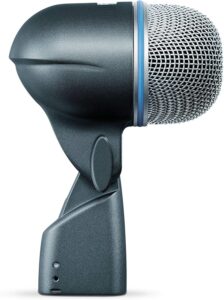
The Shure Beta 52A is my overall choice for most drummers, home studios, and live sound setups. It’s a dynamic microphone designed specifically for kick drums and other bass instruments. That matters because its frequency response isn’t trying to be perfectly neutral.
Shure deliberately shapes the microphone to give bass instruments plenty of low-frequency punch and attack.
The Beta 52A also uses a modified supercardioid pickup pattern. That helps reject unwanted sound arriving from around the microphone, which is particularly useful when recording an entire drum kit.
Your kick microphone is sitting near a snare, toms, cymbals, and possibly guitar amplifiers. Isolation matters. Another useful feature is the built-in locking stand adapter.
Positioning microphones around a drum kit can become frustrating. Stands get bumped, cables get pulled, and vibrations can slowly move poorly secured microphones.
The Beta 52A’s integrated mounting system helps keep the microphone in position. It’s also built to survive live performance.
If you need one bass drum microphone that can move between a studio, rehearsal room, and stage, the Beta 52A is difficult to beat.
Best for: Most drummers, live performance, home studios, and general kick drum recording.
2. AKG D112 MKII – Best Classic Kick Drum Microphone
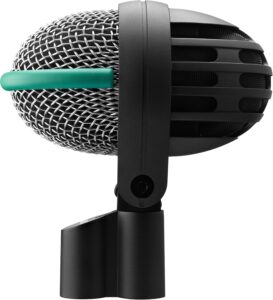
The AKG D112 is one of those microphones you see everywhere once you start paying attention to drum recording. The current D112 MKII continues that familiar design with an integrated flexible mount. This is a large-diaphragm dynamic microphone with a cardioid polar pattern.
AKG specifies a frequency response of 20 Hz to 17 kHz and says the D112 MKII can handle more than 160 dB SPL without distortion. That’s exactly the kind of capability you want around a bass drum.
A kick can create enormous sound pressure, particularly when the microphone is positioned inside the drum. The D112 MKII is designed to take it. AKG also tunes the microphone specifically for bass-heavy sources.
Its low-frequency response provides the weight you want from a kick, while a presence boost around 4 kHz helps bring out the attack.
That combination can make the kick easier to hear in a dense mix. The D112 MKII isn’t limited to drums either. It can also be used on bass guitar cabinets and other low-frequency instruments.
If you want a classic studio kick microphone with decades of history behind the basic design, this is an obvious choice.
Best for: Rock, studio recording, live drums, and bass cabinets.
3. Audix D6 – Best for Rock and Metal
If you like a modern, aggressive kick sound, the Audix D6 should be near the top of your list. The D6 has become particularly popular for styles where the bass drum needs to sound huge while still cutting through dense guitars.
The attraction is the microphone’s pre-shaped sound. Instead of capturing an extremely flat kick and expecting you to build the sound entirely with EQ later, microphones such as the D6 are designed to give you something closer to a finished kick sound from the beginning.
That can save time.
It’s especially useful for live sound, where you may not have hours to experiment with microphone placement and EQ.
The D6 is also compact enough to position relatively easily around or inside a kick drum. If you want a natural jazz-style bass drum sound, another microphone might suit you better. If you want impact, attack, and a modern low end, the D6 is an excellent option.
Best for: Rock, metal, modern live sound, and aggressive kick tones.
4. Sennheiser e 602 II – Best Lightweight Bass Drum Microphone
The Sennheiser e 602 II takes a straightforward approach. It’s a dynamic cardioid microphone specifically designed for low-frequency instruments such as bass drums, bass guitar cabinets, and tubas.
Sennheiser specifies a frequency response of 20 Hz to 16 kHz. The microphone also uses a lightweight aluminum body and an integrated stand mount.
That lightweight construction is more useful than it sounds. Microphone stands around drum kits are often stretched into awkward positions.
A heavy microphone hanging at the end of a long boom arm can cause the stand to slowly move or fall. A lighter microphone makes positioning easier.
Sennheiser also designed the e 602 II for fast transient response and extended low-frequency reproduction. That makes it useful when you want both the body of the kick and the initial hit of the beater. It’s a simple, rugged option that works well in studios, rehearsal spaces, and live venues.
Best for: Live drums, home recording, and easy microphone positioning.
5. Sennheiser e 902 – Best for Live Performance
Another Sennheiser option worth considering is the e 902. It’s designed for low-frequency instruments and is commonly used with kick drums.
For live sound, reliability and isolation are incredibly important. You’re not recording one instrument in a silent studio. There may be guitar amplifiers nearby.
- Bass cabinets.
- Stage monitors.
- Cymbals.
- A loud PA.
- And an audience.
A dedicated dynamic kick microphone makes dealing with that environment much easier.
The e 902 is the type of microphone I’d consider for a drummer who regularly performs live and wants a dedicated kick mic that can remain part of the drum kit.
6. sE Electronics V Kick – Best for Adjustable Kick Sounds
One limitation of many kick microphones is that their sound is heavily predetermined. That can be useful.
But what if you want more control?
The sE Electronics V Kick takes a more flexible approach by giving you switchable voicing options. That lets you change the microphone’s character depending on the kick drum and the style of music.
Maybe you want a deeper, smoother kick for one song. Then you want something with more attack for another. Being able to make changes at the microphone can reduce how much EQ you need later.
This flexibility also makes the V Kick useful for engineers who record different drummers. One kick drum may be a large acoustic drum tuned low. Another may be a smaller drum designed for a tight modern sound. Having a microphone that can adapt is valuable.
Best for: Studio engineers and drummers who want adjustable voicing.
7. Electro-Voice ND68 – Best Alternative Kick Microphone
The Electro-Voice ND68 is another dynamic microphone designed for bass instruments. It’s worth considering if you want something different from the usual Beta 52A, D112, and D6 recommendations.
Like other dedicated kick microphones, the ND68 is designed to capture powerful low frequencies while handling the enormous sound pressure created by drums.
The supercardioid pickup pattern also helps isolate the source from nearby sounds. That makes it useful on crowded stages. A kick microphone doesn’t exist in isolation during a live show.
Every bit of rejection can help reduce cymbals, monitors, and other instruments entering the kick channel.
For someone building a drum microphone collection and comparing different tonal options, the ND68 deserves a listen.
Best for: Live sound, alternative kick tones, and bass instruments.
What Makes a Good Bass Drum Microphone?
A bass drum microphone has a difficult job. First, it needs to handle high sound pressure levels.
A kick drum is loud. Very loud. Place the microphone inside the drum close to the beater and the SPL can become extreme. That’s why dynamic microphones are so common for this job.
They’re rugged and can handle loud sources extremely well. Then there’s frequency response. A kick drum isn’t only bass.
The low frequencies provide the weight and thump. But the higher frequencies contain the attack from the beater. Without enough attack, the kick can disappear behind the bass guitar and other instruments.
That’s why many dedicated kick microphones have a shaped frequency response.
They emphasize the low end while also giving the upper attack frequencies some extra presence.
Dynamic vs Condenser Microphones for Kick Drums
Most of the microphones on this list are dynamic. There’s a reason for that. Dynamic microphones are excellent at handling loud sources and don’t require phantom power.
They’re also generally rugged enough for stage use. Condenser microphones can absolutely be used around bass drums, but they’re more commonly part of specialized or multi-microphone recording setups.
For example, an engineer might place a dynamic microphone inside the kick for attack and another microphone outside the drum for additional low-frequency body.
The two signals can then be blended. For your first bass drum microphone, however, I’d choose a dedicated dynamic model. It’s simpler and much more versatile.
Where Should You Put a Bass Drum Microphone?
Microphone placement can change the sound almost as much as the microphone itself. Place the microphone inside the kick close to the beater and you’ll generally capture more attack.
Move it farther away and the sound can become rounder and less aggressive. Positioning the microphone near the hole in the resonant head can provide a useful balance.
Move the microphone outside the drum and you can capture more of the complete acoustic sound and low-end body. There isn’t one correct position.
- Move the microphone.
- Record ten seconds.
- Listen.
- Move it again.
The best position depends on the drum, tuning, beater, room, microphone, and sound you’re trying to create.
Do You Need Two Kick Drum Microphones?
No. One good microphone can produce an excellent kick recording. But professional engineers sometimes use two.
One microphone may sit inside the kick and focus on the beater attack. Another sits outside and captures the low-frequency body.
Blend the two recordings and you can control the balance between attack and weight. There can also be phase problems when using multiple microphones.
If you’re a beginner, start with one. Learn how positioning affects the sound before making the setup more complicated.
Best Bass Drum Microphone for Live Sound
For live performance, I’d choose between the Shure Beta 52A, Audix D6, and Sennheiser e 602 II.
The Beta 52A is my all-around choice because of its rugged construction, shaped kick response, strong rejection, and integrated mounting system. The D6 makes sense when you want a more aggressive modern sound.
The e 602 II is excellent if lightweight construction and easy positioning are priorities.
All three are purpose-built tools rather than general microphones being forced into kick-drum duty.
Best Bass Drum Microphone for Recording
For studio work, the AKG D112 MKII remains one of my favorite options. AKG gives it a 20 Hz to 17 kHz frequency range, and the microphone can handle more than 160 dB SPL.
Its frequency response is also specifically shaped for low-frequency punch and upper-frequency presence.
That gives you a useful starting sound before you reach for EQ. If you’re recording modern rock or metal, I’d also seriously consider the Audix D6.
Which Bass Drum Microphone Should You Buy?
For most people, I’d choose the Shure Beta 52A. It’s purpose-built for kick drums, rugged enough for live use, and versatile enough for studio recording.
If you want a classic alternative, choose the AKG D112 MKII. For modern rock and metal, look at the Audix D6.
For a lightweight microphone that’s easy to position, the Sennheiser e 602 II is an excellent option.
And if you want more control over the microphone’s voicing, consider the sE Electronics V Kick.
Final Thoughts
The best bass drum microphone isn’t simply the one with the biggest bass response. A good kick sound needs balance. You want low-frequency weight. But you also need enough attack for the drum to remain clear in the mix.
That’s why dedicated bass drum microphones are so useful.
For most drummers and engineers, the Shure Beta 52A is my best overall bass drum microphone. Its dynamic design, modified supercardioid pattern, kick-focused frequency response, integrated mounting system, and rugged construction make it suitable for both studio and stage use.
The AKG D112 MKII is the classic alternative, especially if you want a microphone capable of handling more than 160 dB SPL with a punchy low-frequency response.
But don’t forget microphone placement. Before buying another microphone or adding huge amounts of EQ, move the microphone a few inches.
Listen again. Sometimes the biggest improvement to your kick drum recording costs absolutely nothing.