


Some headphones let you hear bass. Others let you feel it. If you listen to hip-hop, EDM, electronic music, pop, reggae, or bass-heavy movie soundtracks, the low end can be a huge part of the experience. A kick drum should have an impact. A bass guitar should sound full. Sub-bass should reach deep without turning the rest of the music into mud.
But more bass doesn’t automatically mean better bass.
Cheap bass-heavy headphones often boost the low frequencies so aggressively that vocals disappear and everything sounds bloated. Good bass headphones are different. They deliver depth and impact while keeping the rest of the recording clear.
Whether you want a fun pair for everyday listening or a more controlled headphone for studio work, there are plenty of good options.
What is the Best Bass Headphones?
Here are some of the best bass headphones to consider.
1. Meze 99 Classics – Best Overall Bass Headphones
The Meze 99 Classics are my overall pick for listeners who want enjoyable, full-bodied bass without buying headphones that are only about bass. These are closed-back over-ear headphones with 40 mm dynamic drivers.
Meze specifies a frequency range of 15 Hz to 25 kHz, 32-ohm impedance, and 103 dB SPL/mW sensitivity. The relatively low impedance makes them practical with a wide range of equipment. But specifications aren’t the main reason I’d buy them.
The 99 Classics are designed for enjoyable music listening. They have a warm presentation with plenty of low-end body, which makes them particularly attractive for hip-hop, electronic music, pop, and other genres where bass is important.
They’re also unusual-looking. The earcups use real walnut wood, giving the headphones a much more distinctive appearance than the black plastic design found on many studio headphones.
If you want deep, enjoyable bass while still caring about overall sound quality, the 99 Classics are an excellent place to start.
Best for: Music lovers who want rich, warm bass.
2. Audio-Technica ATH-M50x – Best Value Bass Headphones
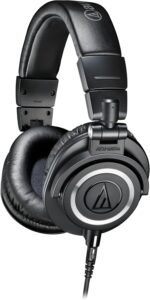
The Audio-Technica ATH-M50x has been popular for years, and it’s easy to understand why. It’s a closed-back studio headphone with 45 mm drivers, a 38-ohm impedance, detachable cables, and swiveling earcups.
The M50x isn’t a dedicated “basshead” headphone. That’s actually one of its advantages. You get satisfying low-end impact without turning every recording into a wall of bass. That makes it much more versatile.
You can listen to hip-hop in the morning, edit a podcast in the afternoon, record vocals in the evening, and watch a movie at night using the same headphones.
The closed-back construction also provides some passive isolation and reduces sound leakage. That’s useful when you’re recording with a microphone.
The ATH-M50x makes the most sense for someone who wants energetic bass but doesn’t want to buy headphones that are useless for everything else.
Best for: Bass lovers who also record, edit, or create content.
3. Beyerdynamic DT 770 PRO X – Best Bass Headphones for Studio Use
Studio headphones aren’t usually designed to produce enormous exaggerated bass. But that doesn’t mean studio users don’t care about low frequencies.
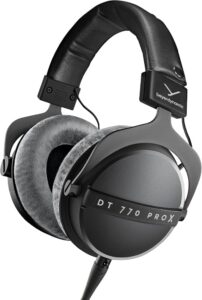
The Beyerdynamic DT 770 PRO X is an interesting option if you want powerful bass with a more professional monitoring-focused design.
Beyerdynamic describes the DT 770 PRO X as having powerful bass and detailed highs. It uses the company’s STELLAR.45 driver and a closed-back design.
The headphones have a 48-ohm impedance and a specified frequency response of 5 Hz to 40 kHz.
That low-frequency extension makes the DT 770 PRO X interesting when you’re working with bass-heavy recordings.
You can hear what’s happening down in the sub-bass region instead of relying entirely on small speakers that may not reproduce it properly.
The PRO X version also adds a detachable mini-XLR cable, something the traditional DT 770 PRO lacks. The velour ear pads are another advantage for long studio sessions.
Best for: Studio monitoring, electronic music production, and long listening sessions.
4. Sony MDR-M1 – Best for Detailed Bass
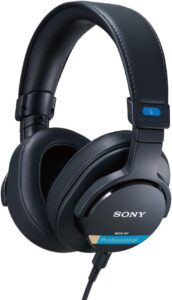
The Sony MDR-M1 takes a more professional approach to low-frequency reproduction. It’s a closed-back studio monitor headphone with 40 mm drivers and a 50-ohm impedance.
Sony specifies an unusually wide frequency response of 5 Hz to 80 kHz. Of course, a huge frequency-response number doesn’t automatically mean a headphone sounds better.
What matters more is how accurately and clearly it reproduces the frequencies you can actually hear. For bass, detail can be just as important as quantity.
If you’re producing music, you need to distinguish between a kick drum and bass line rather than hearing both collapse into one giant low-frequency sound.
That’s why professional monitoring headphones can be attractive even if they aren’t the most exaggerated bass headphones available.
The MDR-M1 is also relatively lightweight at approximately 216 grams without its cable. For long editing and production sessions, that matters.
Best for: Producers and listeners who value bass detail over maximum bass quantity.
5. Sony WH-1000XM6 – Best Wireless Bass Headphones
Wired headphones aren’t for everyone. If you’re commuting, traveling, working in an office, or simply walking around the house, Bluetooth is much more convenient.
Sony’s WH-1000X family has become particularly well known for combining wireless sound with strong active noise cancellation. Noise cancellation can also improve the experience of bass-heavy music.
Imagine listening to hip-hop on an airplane.
The low-frequency rumble from the engines competes directly with the low frequencies in your music. You may respond by turning up the volume.
Good active noise cancellation reduces that background noise, making it easier to hear your music without pushing the volume unnecessarily high.
Wireless models also commonly provide app-based EQ. That’s valuable for bass lovers because you can adjust the low end instead of being permanently stuck with the manufacturer’s default tuning.
Best for: Wireless listening, commuting, flights, and everyday music.
6. Skullcandy Crusher ANC – Best for Extreme Bass
Some people don’t want accurate bass. They want ridiculous bass. That’s where Skullcandy’s Crusher line comes in. Crusher headphones are famous for their adjustable sensory bass system.
Instead of simply increasing low frequencies through ordinary headphone drivers, the Crusher experience is designed to make bass feel physically more intense.
For bass-heavy electronic music and hip-hop, the effect can be a lot of fun. It’s not what I’d choose for professional mixing.
If you’re trying to decide whether a kick drum is 2 dB too loud, headphones deliberately designed to exaggerate bass aren’t the correct tool.
But that’s missing the point. Crusher headphones are about entertainment. They’re for the listener who plays a bass-heavy song and wants the headphones to make it feel huge.
Best for: Bassheads who want maximum physical impact.
7. FiiO FT1 – Best Affordable Audiophile Bass Headphones
The FiiO FT1 is an interesting option for someone moving from mainstream consumer headphones toward more serious wired listening.
It’s a closed-back audiophile headphone that has attracted attention for providing strong low-frequency performance without an extreme price.
A current 2026 roundup from Creative Bloq highlights the FT1 as a leading budget audiophile option, noting its powerful bass alongside clear mids and balanced highs. That’s exactly the balance you want. Bass should be strong when the recording calls for it.
But vocals shouldn’t sound like they’re hiding behind the kick drum. Closed-back construction also makes the FT1 more practical than many open-back audiophile headphones when you’re sharing a room with someone.
If you want to experience deeper, more refined bass without jumping into extremely expensive audiophile gear, the FT1 deserves consideration.
Best for: Affordable audiophile listening and powerful but controlled bass.
8. Sennheiser HD 400U – Best Simple Bass-Forward Wired Option
The Sennheiser HD 400U is another option for people who want a straightforward wired headphone with a bass-forward presentation.
Unlike traditional headphones that rely only on a 3.5 mm analog connection, the HD 400U uses USB-C.
That can be useful with modern phones and laptops that no longer include headphone jacks. This isn’t the headphone I’d choose for serious studio mixing. It’s more of a convenient everyday listening option.
If you want a simple wired connection to a modern USB-C device and enjoy a warmer, bassier presentation, it makes sense.
Best for: Affordable USB-C listening and bass-heavy pop or electronic music.
What Makes Headphones Good for Bass?
Good bass isn’t simply loud bass. There are several things to consider. The first is extension.
Sub-bass lives at the very bottom of the audible frequency range. Headphones that reproduce these frequencies effectively can give electronic music, movie effects, and certain hip-hop tracks a deeper sense of weight.
Then there’s control. A headphone can have huge bass but poor definition. Instead of hearing the kick drum and bass guitar separately, you hear one muddy low-frequency mess.
Good bass headphones maintain definition. You should be able to hear the initial hit of a kick followed by its low-frequency decay. Texture matters too.
An electric bass guitar doesn’t sound the same as a synthesized sub-bass note. Good headphones preserve those differences.
Wired vs Wireless Bass Headphones
Wired headphones are still attractive when sound quality and simplicity matter most. There’s no battery to charge. There’s no Bluetooth codec involved. And professional wired headphones can last for many years.
Wireless headphones provide convenience. They can also give bass lovers something extremely useful: adjustable EQ.
Many Bluetooth headphones let you increase or decrease bass through a companion app. That means you’re not completely dependent on the factory tuning.
For travel and commuting, I’d choose wireless. For a desk, studio, or dedicated listening setup, wired headphones can provide better value.
Best Bass Headphones for Hip-Hop
Hip-hop needs more than enormous sub-bass. Vocals still need to remain clear. Kick drums need impact. Samples and hi-hats need enough high-frequency presence to keep the track energetic.
That’s why I’d choose something such as the Meze 99 Classics or Audio-Technica ATH-M50x rather than automatically buying the bassiest headphones available.
Both provide an enjoyable low end while remaining useful for other types of music.
For someone who specifically wants extreme bass impact, Skullcandy’s Crusher line becomes more interesting.
Best Bass Headphones for EDM
Electronic music can extend extremely deep. Sub-bass is often a fundamental part of the production rather than something happening quietly in the background.
For pure enjoyment, the Meze 99 Classics are an excellent option.
Meze specifies 40 mm dynamic drivers, a 15 Hz–25 kHz range, 32-ohm impedance, and 103 dB SPL/mW sensitivity.
For producing EDM, I’d move toward a studio model such as the Beyerdynamic DT 770 PRO X. The goal changes when you’re producing. You don’t simply want the bass to sound exciting.
You need to understand what the bass is actually doing.
Best Bass Headphones for Music Production
For production, I’d choose the Beyerdynamic DT 770 PRO X or Sony MDR-M1. The DT 770 PRO X gives you a closed-back design, 48-ohm impedance, 5 Hz–40 kHz specified response, detachable cable, and a sound signature Beyerdynamic itself describes as having powerful bass.
The MDR-M1 is another strong option when detail and monitoring accuracy matter. Avoid deliberately extreme bass headphones for serious mixing.
They may make your music sound fantastic while you’re producing it, only for the finished mix to sound weak on normal speakers because you compensated for the headphone’s exaggerated bass.
Do Bigger Drivers Mean More Bass?
Not necessarily. You’ll often see headphone companies advertising 40 mm, 45 mm, 50 mm, or even larger drivers.
Driver size can influence headphone design, but it doesn’t tell you how much bass you’ll hear.
The enclosure, driver material, damping, ear pads, tuning, and fit all affect low-frequency performance. Don’t buy headphones simply because they have the largest driver. Listen to the complete sound.
How Much Bass Is Too Much?
This depends on what you’re doing. For casual music listening, there’s no rule. If enormous bass makes your favorite music more enjoyable, that’s perfectly valid. For mixing and mastering, it’s different.
Exaggerated bass can cause you to make poor decisions. You may reduce bass in your mix because your headphones make it sound too strong.
Play that finished mix through neutral speakers and suddenly there’s not enough bass. That’s why studio headphones generally aim for more controlled low-frequency reproduction.
Fun headphones and accurate headphones don’t always need to be the same thing.
Which Bass Headphones Should You Buy?
For enjoyable music listening, my overall pick is the Meze 99 Classics. They combine a warm presentation with strong low-frequency body and a distinctive closed-back design.
For better value and more versatility, choose the Audio-Technica ATH-M50x.
If you’re producing or recording music, look at the Beyerdynamic DT 770 PRO X or Sony MDR-M1 instead.
For wireless listening and active noise cancellation, Sony’s WH-1000X series is the more practical direction.
And if your definition of “best bass” simply means as much bass impact as possible, Skullcandy’s Crusher series is built around exactly that experience.
Final Thoughts
The best bass headphones aren’t necessarily the headphones with the most bass. Good bass has depth. It has an impact. But it also has control.
You should be able to hear a kick drum hit without losing the vocals. A bass guitar should have texture instead of becoming a low-frequency blur. Electronic sub-bass should extend deep while leaving enough room for the rest of the track.
For most listeners who prioritize enjoyable bass, the Meze 99 Classics are my best overall choice.
For someone who wants a more affordable headphone that can handle music, recording, and everyday listening, the Audio-Technica ATH-M50x is an excellent alternative.
And for professional studio work, I’d lean toward the Beyerdynamic DT 770 PRO X. Choose based on how you’ll actually use your headphones.
Because there’s a big difference between wanting bass that’s accurate and wanting bass that shakes your head. Both can be fun. You just need the right headphones for the job.