


Beyerdynamic is probably better known for headphones than microphones. Models such as the DT 770 PRO and DT 990 PRO have been used in studios for years. But Beyerdynamic also has a long history of making professional microphones for recording, broadcasting, live performance, and content creation.
The interesting part is that you don’t need dozens of different models to find something useful.
For modern creators, two microphones stand out in particular: the Beyerdynamic M 70 PRO X and M 90 PRO X. They may look similar, but they’re designed for very different recording situations.
The M 70 PRO X is a dynamic microphone aimed at podcasts, streaming, broadcast-style vocals, and difficult rooms. The M 90 PRO X is a true condenser designed for detailed studio recording. Which one should you buy?
What is the Best Beyerdynamic Microphones?
Let’s look at the best Beyerdynamic microphones and what they’re good at.
1. Beyerdynamic M 90 PRO X – Best Overall Beyerdynamic Microphone
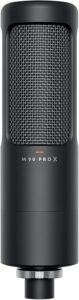
For overall recording versatility, my top choice is the Beyerdynamic M 90 PRO X. It’s a true condenser microphone designed for vocals, speech, and instruments.
Beyerdynamic equips it with a 34 mm condenser capsule and a cardioid polar pattern.
Its frequency response runs from 20 Hz to 20 kHz, while its rated equivalent noise level is only 5.6 dBA. That low noise level is particularly interesting for studio recording.
When you’re recording quiet vocals, acoustic guitar, strings, or other delicate sources, you don’t want the microphone adding unnecessary hiss to the recording.
The M 90 PRO X also handles sound pressure levels up to 133 dB SPL, making it capable of recording considerably louder sources.
Beyerdynamic recommends it for vocals, acoustic guitar, piano, strings, percussion, choir, orchestra, speech, and ambient recording.
You also get a shock mount, pop filter, and carrying bag. The main thing to remember is that this is an XLR condenser microphone. You’ll need an audio interface or mixing console capable of supplying phantom power.
If you have a reasonably quiet room and want one Beyerdynamic microphone for serious home-studio work, the M 90 PRO X is my first choice.
Best for: Vocals, instruments, home studios, voiceovers, and detailed recording.
2. Beyerdynamic M 70 PRO X – Best for Podcasting
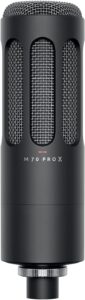
Podcasting is where the M 70 PRO X makes more sense. Unlike the M 90 PRO X, the M 70 is a dynamic microphone. That difference is important.
Condenser microphones tend to be very sensitive. That’s useful in a treated recording studio, but it can become a problem in a normal bedroom or office.
The M 70 PRO X is designed to focus more strongly on a close sound source. Beyerdynamic specifically positions it for streaming, podcasts, radio, YouTube, and broadcast-style speech.
It uses a cardioid pickup pattern and has a frequency response of 25 Hz to 18 kHz when close-miked.
The microphone also includes an integrated elastic suspension system that helps reduce mechanical vibration. Beyerdynamic includes a separate pop filter too.
That’s useful because plosive sounds such as “P” and “B” can create strong bursts of air that hit the microphone capsule.
If you’re building a podcast or streaming setup in an ordinary room, the M 70 PRO X would be my Beyerdynamic pick.
Best for: Podcasting, streaming, YouTube, radio, and untreated rooms.
3. Beyerdynamic TG Series – Best for Live Performance
Beyerdynamic’s microphone lineup isn’t limited to the PRO X studio models. The company’s TG series is aimed more heavily at stage and live-performance applications.
This range includes microphones designed for vocals, drums, instruments, and other live sources.
That’s an important distinction. A studio condenser and a live vocal microphone have very different jobs.
On stage, a microphone needs to deal with loud monitors, guitar amplifiers, drums, movement, handling noise, and feedback.
Durability becomes extremely important too. You don’t want a fragile microphone that you’re afraid to move.
If you’re primarily recording podcasts or vocals at a desk, I’d start with the M 70 or M 90 PRO X.
If your priority is live performance, Beyerdynamic’s TG family is the more appropriate place to look.
Best for: Stage vocals, instruments, drums, and live sound.
M 70 PRO X vs M 90 PRO X: What’s the Difference?
This is the most important comparison for most Beyerdynamic buyers. The M 70 PRO X is dynamic. The M 90 PRO X is condenser. That difference changes how I’d use them.
Choose the M 70 PRO X when you’re recording podcasts, streams, radio-style speech, or vocals in a room that isn’t acoustically perfect.
Choose the M 90 PRO X when you’re recording in a quieter environment and want more detail from vocals and instruments.
The M 70 doesn’t require phantom power itself, but it does need a capable microphone preamp because its output is relatively low.
Beyerdynamic specifically recommends connecting it through a proper XLR audio interface or mixing console rather than a computer’s 3.5 mm microphone input.
The M 90 PRO X does require phantom power. Most modern audio interfaces can provide this.
Do Beyerdynamic Microphones Need an Audio Interface?
The M 70 PRO X and M 90 PRO X use three-pin XLR connections. For a normal computer recording setup, you’ll therefore want an audio interface or mixing console with XLR microphone inputs. The M 90 PRO X needs phantom power.
The M 70 PRO X doesn’t need phantom power, but it needs enough clean preamp gain to reach a healthy recording level. A basic signal chain looks like this:
Microphone → XLR cable → audio interface → computer
Don’t connect the M 70 PRO X to a computer’s cheap 3.5 mm microphone input using a simple adapter and expect professional results. Use a proper interface.
Dynamic vs Condenser: Which Should You Choose?
Choose dynamic when your room is difficult. Choose condenser when your room is quiet and you want more detail. That’s a simplified rule, but it’s a useful starting point.
A dynamic microphone such as the M 70 PRO X works particularly well when the microphone stays close to your mouth.
A condenser such as the M 90 PRO X is more sensitive and can capture subtle details from vocals and instruments. That sensitivity also means it may reveal more of your room.
If your bedroom has hard walls, traffic outside, and a noisy computer, buying the more sensitive microphone isn’t necessarily an upgrade.
Which Beyerdynamic Microphone Should You Buy?
For most serious home-studio users, my overall recommendation is the M 90 PRO X. Its true condenser design makes it versatile enough for vocals, instruments, speech, and other detailed studio recordings.
For podcasting, streaming, and YouTube, I’d choose the M 70 PRO X instead.
It’s purpose-built for spoken-word applications and better suited to challenging acoustic environments.
For live performance, explore Beyerdynamic’s TG series, where you’ll find microphones designed more specifically for stage vocals and instruments.
Final Thoughts
Beyerdynamic’s microphone lineup makes more sense once you stop asking which microphone is “better” and start asking what you’re recording.
The M 70 PRO X and M 90 PRO X are designed for different jobs. The M 70 PRO X is the microphone I’d put on a podcaster’s boom arm. It’s dynamic, cardioid, rugged, speech-focused, and designed to work well when the room around you isn’t perfect.
The M 90 PRO X is what I’d move toward for studio recording.
Its 34 mm true condenser capsule, extremely low rated noise, broad frequency response, and ability to handle loud sources make it suitable for everything from vocals and acoustic guitars to piano and percussion.
For that reason, the Beyerdynamic M 90 PRO X is my best overall Beyerdynamic microphone, while the M 70 PRO X is my top choice for podcasting and streaming.