


Great video can survive imperfect lighting. Bad dialogue is much harder to forgive. If you’re shooting a film, documentary, interview, YouTube video, or commercial, one of the best ways to capture clear dialogue is to place a microphone close to the person speaking while keeping it outside the camera frame.
That’s where a boom microphone comes in. Technically, a “boom microphone” usually isn’t a special type of microphone. It’s typically a directional microphone—often a shotgun mic—mounted on a boom pole.
A boom operator positions it above or below the actor and points it toward their mouth. The result can sound much more natural than recording dialogue with a microphone mounted several feet away on the camera.
For most serious filmmakers, the RØDE NTG5 is my best overall choice because it’s extremely light, highly directional, and designed specifically with location and boom recording in mind.
What is the Best Boom Microphones?
Here are the best boom microphones to consider.
1. RØDE NTG5 – Best Overall Boom Microphone
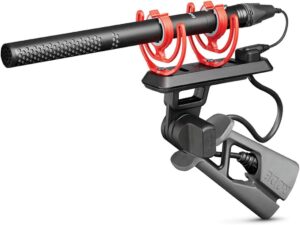
The RØDE NTG5 is my overall pick for filmmakers who want a professional shotgun microphone without adding unnecessary weight to a boom pole. Weight matters more than you might expect. Hold a microphone over an actor for 30 seconds and almost anything feels light.
Hold it there for 20 minutes and you’ll understand why boom operators care about every gram. The NTG5 weighs only 76 grams and measures 203 mm long.
RØDE specifically describes it as a microphone designed with boom operators and location recording in mind.
It’s an RF-bias condenser with a supercardioid shotgun pickup pattern and a 20 Hz to 20 kHz frequency range.
Another important specification is self-noise. RØDE rates the NTG5 at just 10 dBA equivalent noise.
That’s useful when recording quiet dialogue because you don’t want microphone noise becoming obvious when levels are increased.
The NTG5 also includes a windshield, pistol grip/shock mount, cable, and carrying pouch as part of its location recording kit. It requires 48V phantom power. For professional dialogue and location recording, it’s a very complete package.
2. Sennheiser MKE 600 – Best Value Boom Microphone
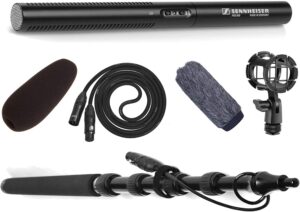
The Sennheiser MKE 600 is one of the easiest shotgun microphones to recommend because it gives filmmakers something incredibly useful: flexible power. You can run it from 48V phantom power. But you can also use an AA battery.
That’s valuable when you’re working with cameras or recording devices that can’t supply phantom power.
Sennheiser gives the MKE 600 a supercardioid/lobar pickup pattern and a frequency response of 40 Hz to 20 kHz.
It’s designed to focus strongly on sound in front of the microphone while reducing noise from the sides and rear. There’s also a switchable low-cut filter. This can help reduce low-frequency rumble and some wind-related noise.
The MKE 600 weighs 128 grams without its battery and measures 256 mm long. It’s heavier and longer than the NTG5, but it’s still manageable on a boom pole.
For independent filmmakers who need one microphone that can work on a camera today and a boom tomorrow, the MKE 600 offers excellent flexibility.
3. Audio-Technica AT875R – Best Budget Boom Microphone
You don’t need to spend hundreds of dollars to start recording dialogue properly. The Audio-Technica AT875R is a compact shotgun microphone that makes a lot of sense for beginners.
It’s only 175 mm long and weighs approximately 80 grams. That’s excellent for boom use. A shorter microphone is easier to maneuver indoors and in small spaces, while the low weight reduces fatigue.
The AT875R uses a line-and-gradient pickup design and has a frequency response of 90 Hz to 20 kHz.
Audio-Technica rates its maximum input level at 127 dB SPL. It requires phantom power, accepting between 11V and 52V DC. That means you’ll need a compatible audio recorder, interface, mixer, or camera.
The AT875R doesn’t offer all the advanced features of more expensive professional shotgun microphones.
But for a student filmmaker or beginner YouTuber learning proper boom technique, it provides a sensible way to get started.
4. RØDE VideoMic NTG – Best for Camera and Boom Use
What if you want one microphone that can spend half its time on your camera and the other half on a boom? Consider the RØDE VideoMic NTG. It’s designed as an on-camera shotgun microphone but offers enough flexibility for other recording setups.
The microphone uses a supercardioid pickup pattern and has a frequency range of 20 Hz to 20 kHz.
It includes useful controls such as high-pass filtering, a high-frequency boost, safety channel functionality, and variable gain. Another major advantage is connectivity. The VideoMic NTG can work with cameras through its analog output while also functioning as a USB microphone with compatible devices.
That’s useful for creators who don’t work exclusively on film sets. You could use it on your camera for a video shoot, put it on a boom for closer dialogue, and later connect it to a computer for voice recording.
A dedicated professional XLR shotgun microphone still makes more sense for a serious production sound kit. For a solo creator, however, versatility can be more valuable.
5. Sennheiser MKE 600 – Best Boom Mic for Beginners Moving Into Professional Work
The MKE 600 deserves another mention because it sits in a useful middle ground. A beginner can understand it. A professional can still use it. That’s important when you’re buying your first serious microphone. Extremely cheap equipment may need to be replaced quickly as your work improves.
The MKE 600 can stay useful. You might start by connecting it directly to a camera. Later, you can mount it on a boom pole and connect it to a professional field recorder through XLR.
The ability to run on an AA battery also means you aren’t completely dependent on phantom power. Sennheiser rates battery operation at approximately 150 hours. That’s a useful backup even if your recorder normally provides phantom power.
6. RØDE NTG3 – Best for Rich Voice Recording
The RØDE NTG3 is another professional shotgun microphone worth considering. Compared with the NTG5, the NTG3 has a more pronounced low-end response. That can give voices a fuller, richer character.
RØDE itself notes that the NTG3’s low-end response makes it particularly suitable for voiceovers and applications where a rich bottom end is desirable.
The NTG5, meanwhile, was developed to be lighter and more optimized for location work. That creates a useful distinction. If your priority is holding a microphone on a boom all day outdoors, I’d choose the NTG5.
If you want a shotgun microphone that will also spend significant time recording rich voiceovers, the NTG3 becomes interesting. Both use RF-bias technology, which is useful for demanding environmental conditions.
7. Professional Short Shotgun Microphones – Best for High-End Production
Once you move into professional film and television production, microphones from companies such as Sennheiser and Schoeps become common choices.
At this level, buying a microphone is less about finding the biggest specification numbers and more about off-axis sound, consistency, reliability, environmental resistance, and how naturally the microphone captures dialogue.
Professional production sound recordists may also own several microphones. A shotgun microphone might be used outdoors. A different hypercardioid or supercardioid microphone may be chosen indoors.
Sound bouncing from walls and ceilings can reach the interference tube from different angles and produce unnatural coloration.
That’s why professional boom recording isn’t simply about buying the longest shotgun microphone available.
What Is a Boom Microphone?
A boom microphone is simply a microphone mounted on the end of a boom pole. The microphone itself is often a shotgun microphone.
The boom pole allows a sound operator to position the microphone close to an actor while keeping both the microphone and operator outside the camera frame. You may see the microphone hanging above an actor’s head.
Sometimes it’s positioned below them and pointed upward. The important thing is distance. Getting a microphone closer to the speaker usually improves the ratio between the voice and unwanted background sound.
That’s why a properly positioned boom microphone can sound dramatically better than an expensive microphone sitting on top of a camera several feet away.
Where Should You Position a Boom Microphone?
A common technique is placing the microphone above the actor and pointing it toward the mouth or upper chest.
Keep it just outside the camera frame. Closer is usually better, provided you don’t accidentally let the microphone appear in the shot. You can also boom from below. That may be useful when the camera framing or lighting makes overhead positioning difficult.
The boom operator should listen through headphones whenever possible. Small movements can change the sound. Good booming is a skill. An experienced boom operator using a modest microphone can often produce better dialogue than a beginner using an extremely expensive one.
Which Boom Microphone Should You Buy?
For most serious filmmakers, choose the RØDE NTG5. For better value and flexible battery or phantom powering, choose the Sennheiser MKE 600.
For beginners on a smaller budget, the Audio-Technica AT875R is a compact and lightweight starting point.
For solo creators who need something that works on both cameras and other devices, consider the RØDE VideoMic NTG.
And if you want a shotgun microphone with a richer low-end character that can also work well for voiceover, look at the RØDE NTG3.
Final Thoughts
The best boom microphone isn’t necessarily the most expensive microphone. Placement matters more.
A $300 microphone positioned 18 inches from an actor will usually be more useful than a $1,000 microphone mounted on a camera across the room.
That’s the entire advantage of a boom pole. It lets you put the microphone where it needs to be without putting it in the picture.
For professional location recording, the RØDE NTG5 is my best overall boom microphone. Its 76-gram body makes it unusually comfortable on a boom, while its highly directional pickup, 10 dBA self-noise, and weather-resistant design make it well suited to demanding filmmaking.
For filmmakers who need something less expensive and more flexible, the Sennheiser MKE 600 is an excellent alternative. It can run from 48V phantom power or an AA battery and includes a switchable low-cut filter.
Whatever you buy, leave room in your budget for a good boom pole, shock mount, headphones, XLR cable, field recorder, and proper wind protection.