


You don’t need a $500 microphone to make a good podcast, record vocals, or start a YouTube channel. In fact, microphone placement, your recording environment, and how you use the mic can matter more than spending hundreds of extra dollars.
The difficult part is choosing the right one. A singer recording in a quiet room has different needs from a podcaster sitting next to a noisy computer. A streamer may want USB simplicity, while someone building a home studio may prefer XLR.
For most beginners, the Samson Q2U is one of the easiest budget microphones to recommend because it gives you both USB and XLR connections. But it isn’t the only good option.
What is the Best Budget Microphones?
Here are some of the best budget microphones to consider.
1. Samson Q2U – Best Overall Budget Microphone
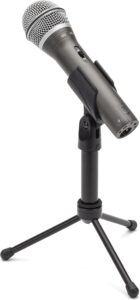
The Samson Q2U is my overall choice for someone buying their first serious microphone. The biggest reason is flexibility. It has both USB and XLR outputs. You can connect it directly to a computer through USB when you’re starting out. You don’t need to buy an audio interface.
Later, if you decide to build a larger recording setup, you can connect the same microphone to an audio interface or mixer through XLR. That makes the Q2U particularly good for podcasting.
It’s also a dynamic microphone with a cardioid pickup pattern. Dynamic microphones are generally useful for spoken-word recording in ordinary bedrooms and offices because you can place them close to your mouth and reduce the relative level of room sound.
The Q2U also has a 3.5 mm headphone output for zero-latency monitoring. Samson includes a desktop tripod, microphone clip, windscreen, USB cable, and XLR cable. That’s a lot of equipment in one affordable package.
2. Audio-Technica AT2020 – Best Budget XLR Condenser Microphone
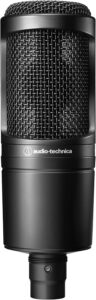
The Audio-Technica AT2020 has become something of a classic in affordable home recording. It’s a side-address condenser microphone with an XLR connection and cardioid polar pattern.
Audio-Technica gives it a frequency response of 20 Hz to 20 kHz and maximum input level of 144 dB SPL.
The AT2020’s condenser design captures plenty of detail, which can be excellent when you’re recording in a reasonably quiet room. But that sensitivity can become a disadvantage in a bad room.
If you have lots of echo, traffic outside, or a noisy computer beside you, a dynamic microphone may be easier to work with. The other thing to remember is that the XLR AT2020 requires 48V phantom power. You’ll need an audio interface or mixer capable of providing it.
If you’re building a proper budget home studio rather than simply looking for a plug-and-play USB microphone, the AT2020 is an excellent starting point.
3. Shure MV6 – Best Budget USB Microphone for Streaming
The Shure MV6 is an interesting option for streamers and creators who want something easy to use. Unlike many inexpensive USB condenser microphones, the MV6 uses a dynamic cartridge.
That makes sense for a gaming or streaming desk. There’s probably a keyboard nearby. Your PC has fans. Maybe your room isn’t acoustically treated.
Shure combines the dynamic design with what it calls Voice Isolation Technology to keep the focus on the person speaking.
The microphone connects through USB-C and works with computers as well as compatible mobile devices.
You also get a 3.5 mm headphone output for real-time monitoring. The software features are particularly useful for beginners.
4. Audio-Technica AT2020 – Best Budget Microphone for Vocals
For singing, I’d return to the AT2020. Vocals are one area where an affordable condenser microphone can provide a noticeable improvement over a basic headset or laptop microphone.
The AT2020’s 20 Hz to 20 kHz frequency response gives it enough range for detailed vocal recording.
It also has a cardioid pattern, meaning it focuses primarily on sound arriving from the front while reducing pickup from the sides and rear.
Don’t expect the microphone to fix your room, though. If you’re recording vocals in an empty bedroom with hard walls, you’ll probably hear reflections.
Soft furniture, curtains, rugs, acoustic treatment, and careful microphone positioning can all help. A pop filter is also worth adding.
For someone building a first vocal recording setup around an audio interface, the AT2020 remains one of the most sensible budget choices.
5. Samson Q2U – Best Budget Podcast Microphone
Podcasting doesn’t require an expensive broadcast microphone. The Q2U demonstrates why. Its dynamic design works particularly well when you place the microphone relatively close to your mouth.
That gives you a strong voice signal while making background sounds less prominent in comparison.
The cardioid pattern also focuses on what’s happening in front of the microphone. But the USB/XLR combination is what makes it such a good podcast microphone.
6. Shure SM58 – Best Budget Microphone for Live Vocals
Sometimes the best budget purchase isn’t the cheapest product. It’s the product you can use for years. The Shure SM58 is a perfect example. It’s a dynamic vocal microphone that has been used on stages around the world for decades.
If you’re primarily performing live, a rugged handheld dynamic microphone makes much more sense than putting a sensitive studio condenser on stage.
The SM58 is built for vocals and live use. It doesn’t need phantom power. Connect it to a mixer, audio interface, or PA system through XLR and you’re ready to work. It can also be used for recording.
The sound won’t be identical to a large-diaphragm condenser, but that can actually be useful in noisy or untreated environments.
If you need one affordable microphone that can survive rehearsals, live shows, and occasional home recording, the SM58 deserves consideration.
7. Fifine USB Microphones – Best for Very Tight Budgets
What if your budget is extremely limited? Fifine has become popular for inexpensive USB microphones aimed at gaming, streaming, online calls, and beginner content creation. These microphones aren’t necessarily what I’d build a professional studio around.
That’s not the point. They provide an affordable upgrade from the microphone built into a laptop or cheap gaming headset. USB also removes the need for an audio interface.
For a student, new streamer, or someone experimenting with podcasting before investing heavily, that can be exactly what you need.
Just pay attention to the specific model. Fifine makes several microphones with different features and pickup designs. Look for a cardioid model if you’re primarily recording one person
What Makes a Good Budget Microphone?
Price isn’t the only thing that matters. A $50 microphone that works perfectly with your setup can be a better purchase than a $150 microphone that requires another $200 of equipment.
Start with connectivity. USB microphones connect directly to a computer and are generally easier for beginners.
XLR microphones connect to audio interfaces, mixers, and professional recording equipment. Then think about your room.
If your bedroom has lots of background noise and reflections, consider a dynamic microphone. If your room is quiet and you’re recording vocals or instruments, a condenser microphone may give you the detail you’re looking for.
Finally, consider accessories. A microphone may look cheap until you realize you also need an interface, XLR cable, stand, shock mount, and pop filter.
Dynamic vs Condenser Microphones
This is another important decision. Dynamic microphones are often excellent for podcasting, streaming, live vocals, and untreated rooms. You normally use them fairly close to your mouth.
Condenser microphones tend to be more sensitive and detailed. That’s useful for studio vocals, acoustic instruments, and other situations where you want to capture subtle sounds. But sensitivity works both ways.
A condenser microphone can capture your beautiful acoustic guitar and the truck driving past your window. Don’t automatically assume condenser means better.
Final Thoughts
The best budget microphone isn’t necessarily the microphone with the lowest price. It’s the microphone that lets you make good recordings without immediately forcing you to buy a pile of additional equipment.
That’s why the Samson Q2U is my favorite budget microphone for most beginners.
Its dynamic cardioid design is well suited to speech, and it gives you USB and XLR connections, a headphone output, and useful accessories in the package.
If you’re building a music-focused home studio, I’d choose the Audio-Technica AT2020 instead.
And if streaming is your priority, the Shure MV6 offers an appealing combination of USB simplicity and automatic processing.