


If you’re buying your first serious microphone, there’s a good chance you’ll end up with a cardioid mic. There’s a simple reason for that.
Cardioid microphones are designed to capture sound primarily from the front while reducing sound coming from the sides and rear. This makes them useful for vocals, podcasts, streaming, instruments, voiceovers, and live performances.
The name “cardioid” comes from the heart-shaped pickup pattern these microphones create. That focused pickup can be especially useful in a home studio. Your microphone can’t magically remove an untreated room, but positioning a cardioid microphone correctly can help reduce unwanted sound.
There are hundreds of cardioid microphones available, ranging from inexpensive USB models to professional studio condensers.
For most studio users, the RØDE NT1 is one of the strongest all-around choices. Podcasters may prefer a dynamic microphone such as the Shure SM7B, while beginners can save money with the Audio-Technica AT2020.
What is the Best Cardioid Microphones?
Here are some of the best cardioid microphones to consider.
1. RØDE NT1 Signature Series – Best Overall Cardioid Microphone
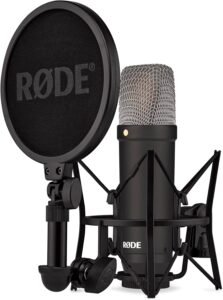
The RØDE NT1 Signature Series is my overall choice for someone building a serious home studio. It’s a large-diaphragm condenser microphone with a cardioid polar pattern.
RØDE gives it a 1-inch true condenser capsule and a frequency range of 20 Hz to 20 kHz. One of its most impressive specifications is noise.
The NT1 Signature Series has a rated equivalent noise level of only 4 dBA. That’s exceptionally quiet for a studio condenser microphone. Low self-noise is useful when recording quiet sources.
Imagine recording a soft singer or delicate acoustic guitar. If the microphone itself produces noticeable noise, that hiss becomes more obvious when you increase the recording level later.
The NT1 can also handle loud sources, with a maximum SPL rating of 142 dB. That combination makes it surprisingly versatile.
You can use it for singing, acoustic instruments, voiceovers, podcasts, percussion, and many other studio applications. The package also includes a shock mount, pop filter, and XLR cable.
2. Shure SM7B – Best Cardioid Microphone for Podcasting
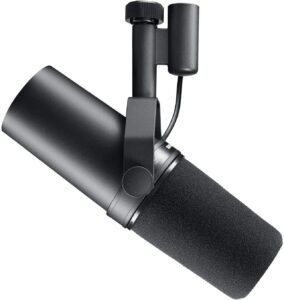
Few microphones are as closely associated with podcasting as the Shure SM7B. It’s a cardioid dynamic microphone designed for close vocal recording. Unlike a sensitive studio condenser, the SM7B works particularly well when placed close to your mouth. That’s useful for podcasting.
Many podcasts aren’t recorded inside professionally treated studios. They’re recorded in bedrooms, offices, and converted spare rooms.
A dynamic microphone can be easier to manage in these environments. The SM7B has a frequency response of 50 Hz to 20 kHz and includes bass roll-off and midrange emphasis controls.
Shure also builds in air-suspension shock isolation and protection against electromagnetic hum. There’s an effective pop filter too, which is particularly useful when you’re speaking close to the microphone.
There is one important consideration. The SM7B has a relatively low output level. For speech and voiceover recording, Shure recommends using a microphone preamp capable of providing at least 60 dB of gain.
3. Audio-Technica AT2020 – Best Budget Cardioid Microphone
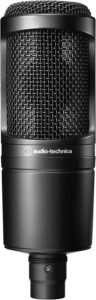
If the NT1 and SM7B are outside your budget, look at the Audio-Technica AT2020. It’s one of the most recognizable affordable studio condenser microphones.
The AT2020 uses a cardioid pickup pattern and has a frequency response of 20 Hz to 20 kHz. Audio-Technica rates it for a maximum input level of 144 dB SPL.
That’s impressive for an affordable microphone and means it can handle more than quiet vocals.
The AT2020 can be used for singing, acoustic guitar, percussion, voiceovers, and many other sources.
Its cardioid pattern reduces pickup from the sides and rear, helping isolate whatever you’ve placed in front of it. The XLR version requires 48V phantom power. You’ll therefore need an audio interface or mixer capable of supplying it.
For someone putting together a first XLR home studio without spending a fortune, the AT2020 remains an excellent starting point.
4. RØDE NT1 5th Generation – Best USB and XLR Cardioid Microphone
What if you want the flexibility of XLR but don’t want to buy an audio interface immediately? The RØDE NT1 5th Generation is an interesting solution. It offers both XLR and USB connectivity.
You can connect it to a traditional audio interface using XLR or plug it directly into a compatible computer through USB.
That gives beginners room to grow. Start with USB. Later, buy an audio interface and move to an XLR workflow without replacing your microphone.
The NT1 5th Generation uses a large-diaphragm cardioid condenser design with a 20 Hz to 20 kHz frequency range.
Like the NT1 Signature Series, it has a rated self-noise level of just 4 dBA and maximum SPL of 142 dB. Its digital connection also supports 32-bit float recording.
For creators who want modern USB convenience without giving up traditional XLR connectivity, it’s one of the most versatile options available.
5. Shure SM58 – Best Cardioid Microphone for Live Vocals
Studio recording isn’t the only reason to choose cardioid. On stage, directional pickup becomes incredibly important. The Shure SM58 is a classic example.
It’s a cardioid dynamic microphone designed primarily for vocals. The cardioid pattern helps focus on the singer while reducing sound coming from other directions.
That’s useful when you have loud stage monitors, guitar amplifiers, drums, and other performers nearby.
6. Shure MV7 Series – Best for Streaming and Content Creation
The Shure MV7 family is a more creator-friendly alternative to traditional broadcast microphones. It’s inspired by the SM7B but designed around modern podcasting and streaming workflows.
Depending on the specific MV7 version, you can get digital connectivity and features that simplify computer-based recording. This makes the MV7 particularly attractive to streamers.
A traditional XLR studio microphone often requires an audio interface, gain setup, cables, and additional equipment.
A digital microphone can make the setup much simpler. The cardioid dynamic design also makes sense around gaming PCs, keyboards, and other equipment.
Position the microphone close to your mouth and keep noisy equipment toward its less-sensitive areas.
7. RØDE PodMic – Best Value Cardioid Podcast Microphone
The RØDE PodMic is another dynamic cardioid microphone designed specifically around speech. It’s built for podcasting, streaming, and other spoken-word applications.
The broadcast-style design looks at home on a boom arm, while the internal pop filtering helps control plosives.
A dynamic podcast microphone can be especially useful when your recording room isn’t perfect. The important thing is placement. Keep the microphone relatively close to your mouth rather than putting it in the middle of a desk.
For creators who want a broadcast-style XLR setup without paying SM7B money, the PodMic is a strong option.
What Is a Cardioid Microphone?
A cardioid microphone is a directional microphone that is most sensitive to sound arriving from the front. It captures less sound from the sides and significantly less from the rear.
If you look at its polar-pattern graph, the pickup area resembles a heart. That’s where the word cardioid comes from.
This pattern is incredibly useful because most recordings have one main source. You usually want to capture that source while reducing everything else. That’s exactly what cardioid microphones are designed to do.
Final Thoughts
There’s a reason cardioid is one of the most common microphone pickup patterns. It’s useful.
Most of the time, there’s one sound you care about and plenty of sounds you don’t. A cardioid microphone helps focus your recording on that main source.
For overall studio use, the RØDE NT1 Signature Series is my best cardioid microphone. Its large-diaphragm condenser design, tight cardioid pattern, 20 Hz to 20 kHz range, extremely low 4 dBA self-noise, and 142 dB maximum SPL make it useful for everything from quiet vocals to loud instruments.