


A good car stereo can play music beautifully and still make your phone calls sound terrible. The problem is often the microphone.
Inside a moving car, your voice has to compete with road noise, tires, engine sound, air conditioning, wind, music, and other passengers. If the microphone is poorly positioned or simply isn’t very good, the person on the other end of the call may struggle to understand you.
An external car microphone can be a surprisingly inexpensive solution
Most car stereo microphones are small condenser mics that connect directly to a compatible head unit. A long cable lets you position the microphone near the driver’s head, usually on the sun visor, dashboard, steering column area, or A-pillar.
The best option depends heavily on your stereo because microphone connectors aren’t universal. Some systems use 3.5 mm inputs, while others use 2.5 mm connectors or proprietary connections.
What is the Best Car Microphones?
Here are some of the best car microphone options and what you should know before buying one.
1. Weishan Universal Car Microphone – Best Overall
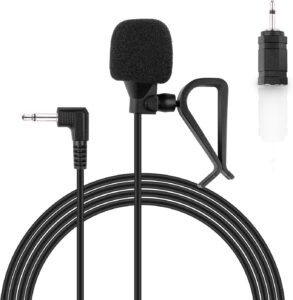
For most aftermarket stereo owners, a universal microphone from Weishan is one of the easiest options to consider. The main advantage is compatibility.
Versions are available with a standard 3.5 mm connector, and some packages include a 2.5 mm adapter. That can make the microphone useful with a wider range of aftermarket head units. It also comes with a long cable.
That’s important because the microphone input is normally located behind or around the stereo, while the ideal microphone position is much closer to your head.
A roughly 10-foot cable gives you enough room to route the wire behind dashboard trim and up toward the visor or A-pillar.
The microphone uses an omnidirectional condenser design, meaning you don’t have to speak directly into one tiny pickup point.
For someone replacing a lost or poor-quality microphone that came with an aftermarket stereo, this is a simple place to start.
2. FingerLakes External Car Microphone – Best Budget Option
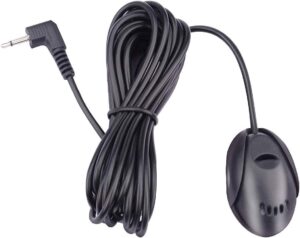
You don’t need to spend much money to improve a poor car stereo microphone. FingerLakes offers simple external microphones designed for compatible Bluetooth-enabled car stereos, GPS units, DVD receivers, and aftermarket head units.
Different versions are available, so connector size is extremely important. You may find 2.5 mm and 3.5 mm versions.
These microphones typically use a long cable and small clip, allowing you to position the mic near the driver. That’s often more important than fancy specifications.
Moving a microphone from the center of the dashboard to somewhere near the driver’s visor can improve the ratio between your voice and the background noise around you.
If you simply need an inexpensive replacement for a missing microphone, a basic FingerLakes model can do the job.
3. Universal 3.5 mm Car Stereo Microphone – Best for Compatibility
Sometimes the smartest choice isn’t a specific brand. It’s buying a good-quality universal 3.5 mm external microphone that matches your head unit. Many aftermarket receivers use a 3.5 mm external microphone input.
These microphones usually include a small electret or condenser capsule, a long cable, a clip, and sometimes a foam windscreen.
Plug the microphone into the appropriate input on your stereo and position it correctly. The downside is that a 3.5 mm plug doesn’t guarantee compatibility.
Two devices can physically use the same connector while expecting different wiring or microphone characteristics.
4. 3.5 mm/2.5 mm Microphone With Adapter – Best for Flexible Installation
If you’re not sure whether you’ll continue using the same stereo, a microphone package that includes both 3.5 mm connectivity and a 2.5 mm adapter can be useful. It gives you more flexibility.
This is especially attractive for installers or people who regularly change aftermarket head units.
A long cable is another feature worth prioritizing. Around three meters, or roughly ten feet, is a practical length for many vehicles.
That lets you hide most of the wire behind trim rather than stretching a visible cable across the dashboard.
Look for a sturdy mounting clip too. A microphone that slowly rotates away from you every time you hit a bump becomes frustrating very quickly.
5. Noise-Reducing External Car Microphone – Best for Highway Driving
Highway driving is one of the toughest tests for an in-car microphone. At low speed, almost any microphone may sound acceptable.
That’s why a microphone with good placement and some form of wind or noise protection can be particularly useful.
Look for models with a foam windscreen. The foam won’t magically eliminate road noise, but it can help reduce direct airflow and certain unwanted sounds reaching the microphone capsule.
Placement is equally important. Don’t mount the microphone directly beside an air-conditioning vent. You don’t want air blowing across the capsule throughout the entire call.
6. Bluetooth Speakerphone – Best for Cars Without a Mic Input
What happens if your car stereo doesn’t accept an external microphone? Don’t try to force a 3.5 mm microphone into an AUX input.
An AUX input is normally designed to receive audio for playback. It isn’t automatically a microphone input. Instead, consider a standalone Bluetooth speakerphone.
These devices usually clip onto the sun visor and connect directly to your smartphone through Bluetooth.
They contain their own microphone and speaker, so they don’t depend on your stereo’s external microphone input.
This can be an excellent solution for an older vehicle without modern hands-free calling.
7. Wireless Lavalier Microphone – Best for Recording Videos in a Car
There’s another reason you might search for a car microphone. Maybe you aren’t trying to make phone calls at all. Maybe you’re recording YouTube videos, TikToks, interviews, or a podcast inside your car.
That’s a completely different job. In that case, don’t buy a basic stereo microphone. Use a proper recording microphone.
A wireless lavalier system such as a DJI Mic or RØDE Wireless Micro puts the microphone close to your mouth and sends the recording to a smartphone or camera. That’s much better for content creation.
A car cabin is actually a challenging recording environment. There are hard reflective surfaces, road noise, air conditioning, and vibration.
Keeping the microphone close to your mouth is one of the easiest ways to get cleaner audio.
What Is a Car Microphone?
A car microphone is usually a small microphone designed to capture the driver’s voice for hands-free phone calls and voice commands.
In an aftermarket stereo system, the microphone commonly connects to a dedicated microphone input on the head unit. The microphone is then installed closer to the driver.
When you make a Bluetooth call, your phone sends the other person’s voice to the car stereo while the external microphone sends your voice back through the system.
The same microphone may also be used for voice assistants and compatible Android Auto or Apple CarPlay functions.
Final Thoughts
For a typical aftermarket stereo, start with the microphone recommended by your head-unit manufacturer.
If you need a universal replacement, a 3.5 mm external condenser microphone with a long cable and visor clip is usually the most practical option when your stereo supports that connection.
A model that includes a 2.5 mm adapter can provide additional flexibility. For an older vehicle without an external microphone input, consider a Bluetooth visor speakerphone instead.
And if you’re recording YouTube videos or other content inside your vehicle, use a proper wireless lavalier microphone system rather than a car-stereo calling microphone.