


A good CB radio is only half of a good communication setup. The microphone matters too. You can have a quality radio and antenna, but if your microphone picks up too much engine noise, wind, or background conversation, other drivers may struggle to understand what you’re saying.
This becomes especially important for truck drivers. A truck cab isn’t exactly a quiet recording studio. You’ve got the engine, tires, air conditioning, road noise, and sometimes an open window competing with your voice.
That’s why many of the best CB microphones use noise-canceling designs. Some CB users prefer a simple dynamic microphone that doesn’t require batteries. Others want an amplified power microphone that can produce a stronger output and give them more control over how they sound.
For most users, the Astatic 636L is one of the easiest CB microphones to recommend. It’s rugged, noise canceling, and specifically designed for close-talking communication in noisy environments.
What is the Best CB Microphones?
Here are some of the best CB microphones to consider.
1. Astatic 636L – Best Overall CB Microphone
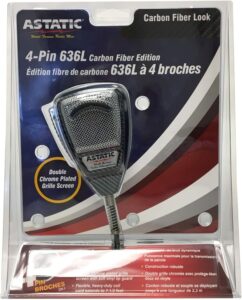
The Astatic 636L is my overall recommendation for someone who wants a straightforward CB microphone that works well in noisy environments. It’s a dynamic noise-canceling microphone designed for close-talking use.
That’s particularly useful in trucks.
Instead of trying to capture everything around you, the microphone is designed to emphasize your voice when you’re speaking very close to it.
The 636L uses a rugged ABS housing and a polyurethane-coated steel grille. It also has a low-impedance dynamic element.
Another advantage is simplicity. There’s no battery to worry about. You don’t need to adjust an amplifier every time you use the radio.
Press the push-to-talk button, hold the microphone close to your mouth, and speak.
The standard version is commonly available with a four-pin connection compatible with many popular CB radios, although wiring can vary.
The most important thing to understand is microphone technique.
The 636L is meant to be used very close to your mouth. Move it too far away and your transmitted audio can become much weaker.
2. Astatic Road Devil RD104E – Best Amplified CB Microphone
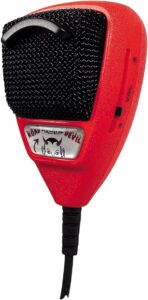
If you want more output and control than the 636L provides, consider the Astatic Road Devil RD104E. This is an amplified noise-canceling microphone. It contains a high-gain amplifier with electronic equalization designed to increase talk power and intelligibility.
There’s an external gain control that lets you adjust the microphone’s output. That flexibility is useful, but it also means you need to set it correctly. More gain isn’t automatically better.
Turning the microphone up too high can lead to feedback, distortion, and an unpleasant transmitted signal.
The Road Devil uses an amplified electret element and requires a standard 9V battery.
It has a specified frequency response of 50 Hz to 10 kHz and uses a rugged ABS housing with a steel grille.
Like the 636L, it’s designed for close talking.
3. Ranger SRA-198 – Best CB Microphone for Truckers
The Ranger SRA-198 is another popular noise-canceling microphone designed for demanding mobile environments.
Its main purpose is straightforward: keep your voice understandable when there’s a lot of noise around you.
That makes it particularly attractive for truck drivers. The SRA-198 uses a close-talking design, so microphone positioning is important. Hold it close to your mouth.
If you try speaking into a noise-canceling microphone from several inches away, you may be disappointed with the output.
The microphone is commonly wired with a four-pin Cobra/Uniden-style connection, and its cable can stretch to approximately six feet depending on the version.
Its specified frequency response is around 50 Hz to 15 kHz.
Ranger has also supplied SRA-198 microphones with some of its radios, which tells you the type of equipment and users the microphone is designed around.
4. Astatic 636L – Best Noise-Canceling CB Microphone
The 636L gets another recommendation because noise cancellation is one of its biggest strengths. There’s an important distinction here. This isn’t electronic active noise cancellation like you’d find in modern headphones.
The microphone’s physical and acoustic design helps it favor your close voice while reducing surrounding noise.
That’s why you have to hold it properly. Astatic’s close-talking design means the microphone should be very near your mouth. This might feel strange if you’re used to holding a normal microphone several inches away.
But once you understand the technique, it makes sense. Your voice is extremely loud at the microphone because you’re so close. Engine and road noise are much farther away. That gives the microphone a much better voice-to-background-noise ratio.
5. Astatic Road Devil – Best Power Microphone
Power microphones have been popular among CB enthusiasts for decades. The idea is to amplify the microphone’s signal before it reaches the radio. The Road Devil is a good example.
Its built-in amplifier gives you adjustable output, allowing you to match the microphone more closely to your voice and radio setup.
This can be particularly useful for soft-spoken operators. But power microphones need to be treated carefully.
If your radio already has plenty of microphone gain, adding too much amplification can make your signal sound worse instead of better.
6. Ranger SRA-198 – Best Alternative to the Astatic 636L
If you’re considering the Astatic 636L but want another noise-canceling option, look at the Ranger SRA-198. Both microphones are designed around close-talking communications. Both are popular with drivers.
And both are intended to reduce the effect of noisy surroundings. Which sounds better can depend on your voice, radio, microphone gain settings, and personal preference.
That’s important with CB microphones. There isn’t always one model that sounds objectively best on every radio. Some microphones match particular voices and radios better than others.
7. Stock OEM CB Microphone – Best for Simplicity
Don’t automatically assume you need to replace your original microphone. The microphone included with a quality CB radio may be perfectly adequate for normal use.
If people consistently tell you that your transmitted audio sounds clear, there may be no reason to change anything.
An aftermarket microphone becomes useful when you’re trying to solve a particular problem. Maybe there’s too much background noise.
Maybe your original microphone broke. Maybe you want stronger audio. Or perhaps you simply don’t like how the original microphone feels in your hand.
Upgrading without knowing what you’re trying to improve can lead to spending money without getting better results.
Final Thoughts
For most CB users, the Astatic 636L is my best overall CB microphone. It’s rugged, simple, doesn’t need a battery, and is specifically designed to improve communications in noisy environments.
For an amplified microphone, choose the Astatic Road Devil RD104E. It combines noise cancellation with a high-gain amplifier and adjustable output.
For truckers who want an alternative to Astatic, the Ranger SRA-198 is another strong choice.
But before buying any of them, check your radio’s microphone connection and wiring. Compatibility comes first.