


You don’t need an expensive microphone to sound good. That’s especially true if you’re starting a podcast, YouTube channel, home studio, or streaming setup. Plenty of affordable microphones can produce clean, professional-sounding audio when they’re positioned correctly.
The trick is buying the right type of microphone. Some cheap microphones connect directly to your computer through USB. Others use XLR and require an audio interface or mixer. Dynamic microphones can be a great choice for bedrooms and untreated rooms, while condenser microphones are often better when you want to capture more detail.
For most beginners, the Samson Q2U is one of the best places to start. It gives you both USB and XLR connections, so you can use it without an audio interface today and move to a more advanced setup later.
What is the Best Cheap Microphones?
Here are some of the best cheap microphones worth considering.
1. Samson Q2U – Best Cheap Microphone Overall
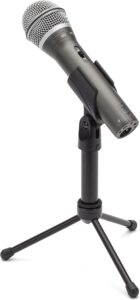
The Samson Q2U is my overall recommendation for anyone looking for an inexpensive microphone for podcasting, streaming, or general voice recording. Its biggest advantage is connectivity. The Q2U gives you both USB and XLR outputs.
If you’re a beginner, connect the microphone directly to your computer through USB. You don’t need to purchase an audio interface.
Later, you can use the XLR output with an audio interface, mixer, or PA system. That makes the Q2U particularly useful for podcasters.
It’s a dynamic microphone with a cardioid pickup pattern. This means it focuses primarily on sound coming from the front while reducing sounds coming from the sides and rear.
The dynamic design is also useful in ordinary bedrooms and offices where background noise and room reflections can be a problem.
There’s even a 3.5 mm headphone output with volume control for zero-latency monitoring.
Samson includes a desktop tripod, microphone clip, windscreen, USB cable, and XLR cable, giving beginners most of what they need in one package.
2. Audio-Technica ATR2100x-USB – Best Cheap USB/XLR Microphone
The Audio-Technica ATR2100x-USB follows a similar idea to the Samson Q2U.
It’s a dynamic cardioid microphone with both USB-C and XLR outputs.
That flexibility is incredibly useful.
Connect it directly to your laptop when you’re recording a podcast at home. If you eventually buy an audio interface, you can switch to XLR without replacing the microphone.
Audio-Technica gives the ATR2100x-USB a frequency response of 50 Hz to 15 kHz.
Its digital connection supports recording at up to 24-bit/192 kHz.
There’s also a 3.5 mm headphone jack and dedicated headphone volume control, allowing you to hear yourself without the distracting delay that can occur when monitoring through recording software.
The package includes USB-C to USB-C, USB-C to USB-A, and XLR cables along with a small desktop stand.
3. Shure PGA48 – Best Cheap Microphone for Vocals
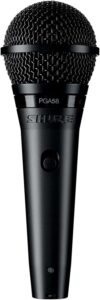
If you need a cheap microphone primarily for speaking, karaoke, or casual live vocals, consider the Shure PGA48. It’s a traditional XLR dynamic microphone. That means there’s no USB connection. You’ll need a compatible mixer, audio interface, PA system, or other equipment with a microphone input.
Shure specifically tunes the PGA48 for clarity in the standard speech frequency range.
It has a cardioid pickup pattern and a frequency response of 70 Hz to 15 kHz. There’s also a physical on/off switch on the microphone.
Depending on which version you buy, it can come with an XLR-to-XLR or XLR-to-1/4-inch cable.
For someone who needs an inexpensive handheld microphone for karaoke, announcements, rehearsals, or basic vocal work, it’s a practical option.
4. Behringer XM8500 – Best Ultra-Cheap XLR Microphone
If your budget is extremely tight, the Behringer XM8500 is worth considering. It’s a handheld dynamic microphone designed for vocals and live applications.
The big attraction is value. You get a conventional XLR microphone without paying much money, making it useful for people building inexpensive rehearsal, karaoke, or basic recording setups.
Because it’s dynamic, you don’t need phantom power. However, you will need something to connect it to. That’s an important distinction when comparing cheap USB and XLR microphones.
An inexpensive XLR microphone may appear cheaper, but if you don’t already own an audio interface, mixer, or PA system, the complete setup can cost considerably more.
If you already have an interface, though, a cheap XLR dynamic microphone can offer excellent value.
5. Fifine USB Microphones – Best Cheap Microphone for Gaming
Fifine makes several inexpensive USB microphones aimed at gamers, streamers, and beginner content creators.
The exact model you should choose depends on your budget and setup. But the appeal is generally the same. They’re easy. Instead of buying a microphone, interface, XLR cable, stand, and other equipment separately, you can get a USB microphone and connect it directly to your PC.
Some Fifine models also include RGB lighting, which fits naturally into gaming setups. Are these microphones going to replace expensive professional studio equipment? Probably not. But that’s missing the point.
If you’re currently using the microphone built into a laptop or a cheap gaming headset, even an affordable dedicated USB microphone can be a meaningful improvement.
Final Thoughts
For most people, the Samson Q2U is my best overall cheap microphone.
Its USB and XLR connectivity gives beginners an easy starting point without limiting future upgrades. You also get a cardioid dynamic capsule, headphone monitoring, and useful accessories in the package.
The Audio-Technica ATR2100x-USB is an excellent alternative, especially if you value its higher-resolution USB recording capabilities.
For karaoke and basic live vocals, consider the Shure PGA48.
For gaming on an extremely tight budget, a simple Fifine USB microphone may be all you need.
And if you already own an audio interface, an inexpensive XLR dynamic microphone can provide excellent value.