


Good videos get people to click. Good audio gets them to keep watching. You can own an expensive camera, beautiful lens, and professional lighting setup, but viewers will notice immediately if your voice is difficult to understand. Echo, wind, keyboard noise, and distant-sounding dialogue can make an otherwise great YouTube video feel amateur.
Fortunately, you don’t need an expensive recording studio.
The best YouTube microphone depends mainly on how you create videos. Someone recording tutorials at a desk needs a different microphone from a travel vlogger walking around outside.
For desk-based creators, a USB or dynamic podcast microphone is usually easiest. Vloggers may prefer an on-camera shotgun microphone. Interview and travel creators can benefit from wireless microphones.
What is the Best YouTube Mics?
Here are some of the best YouTube mics to consider.
1. Shure MV7+ – Best Overall YouTube Microphone
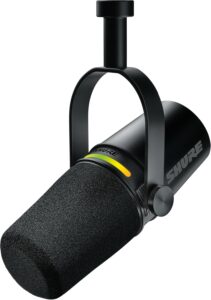
The Shure MV7+ is my overall recommendation for YouTubers who record primarily at a desk or in a home studio. It’s a dynamic microphone designed for podcasting, streaming, and content creation.
One of its biggest advantages is connectivity. You get both USB-C and XLR. That means a beginner can connect the microphone directly to a computer without buying an audio interface. If you eventually build a more advanced studio, you can use the XLR connection instead.
The dynamic design is also useful in ordinary bedrooms and offices.
Condenser microphones can be extremely sensitive, which is great in a treated studio but sometimes frustrating in a room with computer fans, traffic, and reflections.
A dynamic microphone positioned close to your mouth can make it easier to keep your voice prominent.
The MV7+ also includes digital processing features such as Auto Level Mode, a real-time denoiser, and a digital pop filter.
For talking-head videos, tutorials, livestreams, gaming, and voiceovers, it’s a very versatile option.
2. RØDE VideoMic GO II – Best YouTube Mic for Vlogging
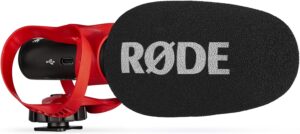
If your camera moves with you, putting a desktop microphone in front of your face obviously isn’t practical. That’s where the RØDE VideoMic GO II comes in. It’s a compact directional microphone that can mount directly on a camera.
The microphone weighs only 89 grams, so it doesn’t add much weight to a mirrorless or compact video setup. More importantly, it gives you two connection options.
There’s a traditional 3.5 mm TRS output for cameras and a USB-C connection for compatible smartphones, tablets, and computers. That makes the VideoMic GO II unusually flexible.
You could use it on your camera while vlogging and then connect it to your computer to record narration. It also doesn’t require batteries when used with compatible equipment.
For YouTubers who regularly switch between camera, computer, and mobile recording, that’s incredibly convenient.
3. DJI Mic 3 – Best Wireless Microphone for YouTube
A camera-mounted microphone works well when you’re relatively close to the camera. But what happens when you walk 15 feet away? The microphone stays with the camera.
Your voice doesn’t. A wireless microphone solves that problem. The DJI Mic 3 is designed for creators who need to move while recording.
A small transmitter clips onto your clothing and stays close to your mouth. The audio is transmitted wirelessly to a receiver connected to your camera or another compatible recording device.
For professional creators, internal recording and advanced wireless features also provide more protection when something goes wrong during a shoot.
4. Shure SM7B – Best Professional YouTube Microphone
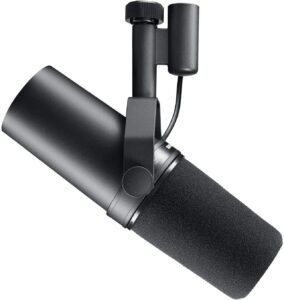
If you’ve watched enough podcasts and YouTube channels, you’ve probably seen the Shure SM7B. It’s the large broadcast-style microphone commonly mounted on a boom arm beside someone’s face.
The SM7B is a dynamic cardioid microphone known for its smooth vocal sound. It’s especially good for spoken-word recording.
That includes podcasts, voiceovers, livestreams, commentary videos, and long-form YouTube content.
But there’s a catch.
The SM7B isn’t a beginner plug-and-play USB microphone. It’s an XLR microphone. You’ll need an audio interface or mixer with enough clean gain. That adds cost and complexity. If you’re starting your first YouTube channel, you probably don’t need an SM7B.
5. RØDE VideoMic NTG – Best On-Camera YouTube Microphone
The VideoMic NTG is a step up for creators who want more control from an on-camera microphone. It’s a directional shotgun-style microphone with features designed for video production.
You get variable gain control, high-pass filtering, a safety channel, and other tools for handling different recording situations.
It also has a built-in rechargeable battery capable of more than 30 hours of operation.
Another useful feature is USB. The VideoMic NTG can function as a USB microphone when connected to compatible computers and other devices. This makes it much more versatile than a microphone that works only with cameras.
A YouTuber could film outside with it in the morning, bring it home, connect it to a computer, and record a voiceover later.
6. RØDE PodMic – Best Value YouTube Microphone
Not every creator wants to spend SM7B money. The RØDE PodMic family provides a more affordable broadcast-style alternative. It’s particularly useful for spoken-word content.
Put it on a boom arm, keep it reasonably close to your mouth, and you’ve got the classic YouTube/podcast studio look. The dynamic design also makes sense in home recording environments.
If your room isn’t professionally treated, working close to a dynamic microphone can help make your voice stronger relative to the sound of the room.
There are different PodMic versions available, so check connectivity before buying.
If you want the simplest computer setup, USB connectivity is useful. If you already have an audio interface or mixer, an XLR setup may make more sense.
7. RØDE Wireless Micro – Best for YouTube Shorts and Smartphones
Not every YouTube creator uses a traditional camera anymore. You may shoot everything on your phone. For Shorts and mobile videos, a tiny wireless system such as the RØDE Wireless Micro can be much more practical than carrying a shotgun microphone and camera rig.
The concept is simple. Clip a small transmitter to your clothing. Connect the receiver to your smartphone. Start recording.
Because the microphone stays close to your mouth, your voice remains relatively consistent even when the phone is several feet away. That’s extremely useful when filming yourself.
You can put your phone on a tripod and walk around without shouting toward it. For creators producing Shorts, travel clips, demonstrations, and social videos, simplicity matters.
What Type of Microphone Is Best for YouTube?
There’s no single answer because “YouTube video” can mean almost anything. If you’re sitting at a desk, consider a dynamic USB microphone. The Shure MV7+ is an excellent example.
If you’re vlogging with a camera, use a directional on-camera microphone such as the RØDE VideoMic GO II or VideoMic NTG.
If you’re walking around or recording interviews, wireless makes more sense. A DJI Mic system lets the microphone stay close to the speaker even when the camera moves farther away.
And if you’re building a professional voice-focused studio, an XLR microphone such as the Shure SM7B becomes attractive.
Start with your recording style rather than buying whatever microphone your favorite YouTuber happens to use.
Final Thoughts
For desk-based creators, the Shure MV7+ is my best overall YouTube microphone. It offers the convenience of USB-C along with XLR for more advanced setups, making it suitable for beginners and experienced creators. For vloggers, choose the RØDE VideoMic GO II.
For creators who need to move around, choose a DJI wireless microphone system. For a professional voice-focused studio, consider the Shure SM7B.
For an affordable broadcast-style setup, look at the RØDE PodMic. And for smartphone-based Shorts and mobile videos, the RØDE Wireless Micro is a convenient option.