


If you’re ready to move beyond a basic USB microphone, XLR is usually the next step.
XLR microphones are widely used in recording studios, podcast studios, live venues, radio stations, and professional video productions. Instead of connecting directly to your computer, an XLR microphone normally plugs into an audio interface, mixer, recorder, or microphone preamp.
This creates a little more complexity, but it also gives you more control.
You can choose your microphone separately from your audio interface. You can add multiple microphones later. And if one part of your setup needs upgrading, you don’t necessarily have to replace everything.
The harder part is choosing the right microphone.
A podcaster may want a dynamic microphone that works well close to the mouth. A singer recording in a quiet studio may prefer a large-diaphragm condenser. A live performer needs something durable enough to survive being carried from venue to venue.
For most studio users, the RØDE NT1 Signature Series is one of the best all-around XLR microphones. For podcasting and broadcasting, the Shure SM7B remains an excellent choice.
What is the Best XLR Mics?
Here are some of the best XLR mics to consider.
1. RØDE NT1 Signature Series – Best Overall XLR Microphone
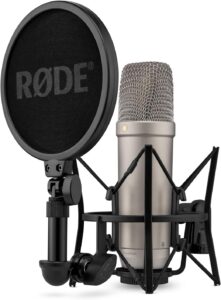
The RØDE NT1 Signature Series is my overall recommendation for someone who wants a versatile studio XLR microphone. It’s a large-diaphragm condenser microphone with a cardioid polar pattern.
That combination makes it useful for a wide range of recordings, including singing, voiceovers, acoustic guitar, piano, percussion, and podcasting.
One of the NT1’s biggest strengths is its extremely low self-noise. RØDE rates the NT1 Signature Series at just 4 dBA of equivalent noise. That can be particularly helpful when you’re recording quiet sound sources because the microphone itself contributes very little audible noise. It can handle loud sources too.
The microphone has a maximum SPL rating of 142 dB, giving it enough headroom for many louder instruments.
RØDE includes a shock mount, pop filter, and XLR cable in the package. The main thing beginners need to know is that the NT1 requires 48V phantom power. You’ll therefore need an audio interface, mixer, or preamp capable of supplying phantom power.
2. Shure SM7B – Best XLR Microphone for Podcasting
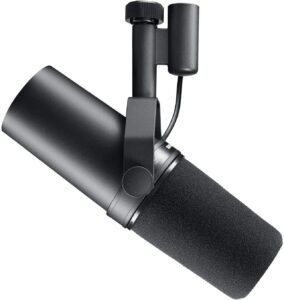
The Shure SM7B is probably one of the most recognizable podcast microphones in the world. It’s a dynamic cardioid microphone designed for professional speech, vocals, broadcasting, and studio recording.
Unlike a sensitive condenser microphone, the SM7B is commonly positioned quite close to your mouth.
That makes it particularly useful for podcasting. When you keep a dynamic microphone close to the speaker, the voice becomes much stronger relative to room reflections and other background sounds.
The SM7B also includes internal air-suspension shock isolation to reduce mechanical noise. There’s an effective pop filter, along with bass roll-off and midrange presence controls. Shure specifies a frequency response of 50 Hz to 20 kHz. There is one important catch. The SM7B has relatively low output.
3. Audio-Technica AT2020 – Best Budget XLR Microphone
You don’t have to spend hundreds of dollars to start using XLR. The Audio-Technica AT2020 has been a popular entry point into home-studio recording for years. It’s a cardioid condenser microphone designed for studio use.
Its relatively affordable price makes it attractive to singers, musicians, podcasters, and beginner producers building their first XLR setup.
A condenser microphone like the AT2020 is sensitive enough to capture plenty of detail. That can be excellent for vocals and acoustic instruments. However, it also means your recording environment matters.
Put a sensitive condenser microphone in a large empty bedroom and you may hear a lot of room reflections.
For the best results, record in a relatively quiet room and position the microphone carefully. Like most XLR condenser microphones in this category, you’ll need an audio interface or mixer with phantom power.
4. Shure SM58 – Best XLR Microphone for Live Vocals
If you need a microphone for performing live, the Shure SM58 is difficult to ignore. It’s a cardioid dynamic vocal microphone that’s built for stage use.
The design is simple. There are no batteries. No USB connection. No software. Plug an XLR cable into the microphone, connect it to your mixer or audio interface, and start using it.
The dynamic capsule can handle loud vocals, while the cardioid pickup pattern helps reduce sound arriving from unwanted directions.
That’s particularly useful on stage, where your microphone may be surrounded by speakers, drums, guitar amplifiers, and other performers.
The SM58 is also famous for being rugged. You can use one for recording too. It may not capture the same fine detail as a studio condenser, but that can actually work in your favor when recording in a noisy or untreated environment.
5. RØDE PodMic – Best Value XLR Podcast Microphone
The RØDE PodMic is designed specifically around spoken-word recording. It’s a dynamic broadcast-style microphone that looks right at home mounted on a boom arm.
This makes it particularly appealing to podcasters and YouTubers who want a professional-looking setup without paying SM7B prices. The dynamic design is another advantage.
If your podcast studio is actually a spare bedroom, you may not want an extremely sensitive condenser microphone capturing every reflection in the room.
Position the PodMic close to your mouth and you can get a focused vocal recording.
RØDE also builds pop filtering into the design to help reduce plosives from sounds such as “P” and “B.”
For someone building an XLR podcast setup on a reasonable budget, the PodMic is an easy microphone to consider.
6. RØDE NT1 5th Generation – Best Hybrid XLR Microphone
The NT1 5th Generation is unusual because it doesn’t force you to choose between XLR and USB. It provides both. RØDE calls this its Dual Connect output. Connect it to an audio interface using the traditional three-pin XLR connection, or use USB-C and connect it directly to a compatible computer.
That makes the NT1 5th Generation particularly useful for someone building their first serious studio.
You can start with USB if you don’t own an interface. Later, move to XLR. The microphone itself can stay.
The NT1 5th Generation is a large-diaphragm cardioid condenser with a 20 Hz to 20 kHz frequency range. RØDE rates its self-noise at 4 dBA and maximum SPL at 142 dB. Its digital USB mode also supports 32-bit float recording.
7. Shure SM57 – Best XLR Microphone for Instruments
The Shure SM57 is another microphone that has been used professionally for decades. It’s a dynamic microphone commonly associated with instruments. Guitar amplifiers are a classic example. Snare drums are another.
The SM57’s compact design makes it easy to position close to instruments, while the dynamic capsule handles high sound levels well. You can also use an SM57 for vocals and speech.
It may not look like a podcast microphone, but microphones don’t care how they look on camera.
If you need one affordable XLR microphone that can move between guitar amps, drums, vocals, and other recording jobs, the SM57 is incredibly useful.
It’s especially attractive for someone building a studio gradually. You may continue finding uses for an SM57 even after buying much more expensive microphones.
Final Thoughts
For most home-studio users, the RØDE NT1 Signature Series is my best overall XLR microphone.
It offers a large-diaphragm cardioid condenser capsule, a 20 Hz to 20 kHz frequency range, exceptionally low 4 dBA self-noise, and a maximum SPL of 142 dB. It also includes a shock mount, pop filter, and XLR cable.
For podcasting and broadcasting, choose the Shure SM7B. For a budget studio, consider the Audio-Technica AT2020.
For live vocals, get the Shure SM58. For podcasting on a smaller budget, look at the RØDE PodMic.
And if you want both USB and XLR connectivity, the RØDE NT1 5th Generation gives you both in one microphone.