

If you’re just starting out as a singer, podcaster, or public speaker, finding the right microphone can feel overwhelming. With so many high-end options costing hundreds or even thousands of dollars, it’s easy to feel lost. But what if you simply need something reliable, sturdy, affordable, and capable of making you sound great?
That’s where the Shure SM48 comes in. This powerful vocal microphone is known for Shure’s legendary toughness and sound quality, but at a price that’s easy on your wallet. Frequently called the “little brother” of the famous SM58, the SM48 gives you clear vocals, a tough build, and a price tag that’s friendly to beginners and and working musicians.
But is it still worth picking up in 2026? Let’s jump in and see if the SM48 is still a smart buy.
What is the Shure SM48?
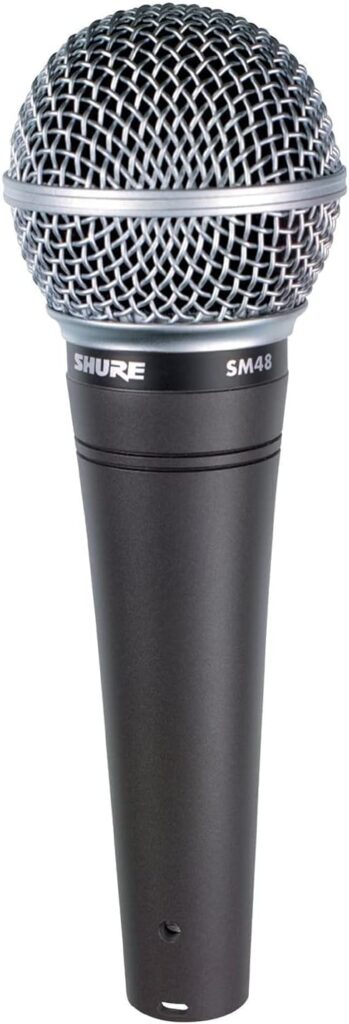
The Shure SM48 is a dynamic cardioid microphone which is mainly used for vocals in live sound, karaoke, and beginner recording. Together with the SM58 it is constructed to be durable and reliable, but it is offered at a cheaper price in order to make professThe speaker has a frequency response that is designed for vocals, with a focus on midrange clarity as well as the elimination of low-end rumble. Because of this, it is suitable for use in liv makes it well-suited for stage for performance, and spoken word applications.
Think of it like a trusty, budget-friendly car: it won’t blow you away with fancy features, but it’ll always get the job done without any fuss.
Who made the Shure SM48?
Shure Incorporated, the company behind the SM48, has been making pro audio gear for almost a century. They’re the folks who brought us classics like the SM58 and SM7B. If you ask any musician or sound engineer, chances are they’ve trusted a Shure mic at some point.
The SM48 was created as a wallet-friendly way to get that Shure reliability and sound, without paying for bells and whistles you might not need. It’s become a go-to for cost-conscious musicians, karaoke hosts, schools, and churches.
Top Benefits of the Shure SM48
It’s affordable, giving you pro-level quality at a beginner’s price. Your voice comes through clearly—whether you’re speaking or singing, you’ll be easy to hear. The cardioid pickup pattern helps block out background noise and keeps feedback to a minimum. Built to survive drops, travel, and whatever gigs throw at it.
An internal shock mount keeps those annoying handling noises under control when you’re performing. It even has a built-in pop filter, so you don’t need extra gear to block those pesky ‘p’ and ‘b’ sounds. Shure’s reliability has been proven over decades of use.
Best Features of the Shure SM48
The SM48 is equipped with a number of features that set it apart in its price range. Let’s examine them.
Tailored Frequency Response
It has been optimized for vocals by improving the midrange and cutting back in the bass to manage the proximity effect.
Cardioid Polar Pattern
It picks up sound from the front while filtering out noise coming in from the sides and back—rendering it suitable for noisy places such as bars or live stages.
Rugged Steel Mesh Grille
It guards the capsule against drops and impacts, just like the SM58, which is likewise built to last.
Shock-Mounted Cartridge
Reduces noise and vibrations caused by handling, which is important in the case of handheld performances.
Built-In Pop Filter
It reduces plosive sounds like “p” and “b”, which causes smoother vocals.
Wide Compatibility
It is compatible with any standard XLR setup—whether that be mixers, audio interfaces, or PA systems.
Shure SM48 Pricing
In 2025 the Shure SM48 usually costs between $40 and $50 USD.
It is therefore one of the cheapest microphones that offers professional quality on the market. The SM48 offers good value for money, the cost of which is about half that of the SM58, particularly for those who are just starting out or who have a budget.
Shure SM48 Pros and Cons
Let’s examine the areas in which the SM48 performs well and the ones in which it falls short.
Shure SM48 Pros
- It’s very cheap; indeed, it’s hard to find anything superior within its price range.
- The sound quality is good since it is clear and appropriate for use with vocals and speech.
- Durable, thanks to Shure’s traditional toughness.
- The cardioid pickup is capable of reducing both feedback and unwanted noise.
- There’s no requirement for phantom power—just enjoy the simplicity of plug and play.
- It’s a good starter microphone and is ideal for use in karaoke, for practice, or when people are performing for the first time.
Experts regard it as a favored option in schools, small venues, churches, and home studios that are looking for reliable and low-cost alternatives.
Shure SM48 Cons
- The frequency range is limited (55 Hz to 14 kHz) and this means that it picks up less detail than premium microphones.
- It generates more handling noise than the SM58 and is less tolerant when used in a handheld manner.
- In comparison with the well-known SM58, the Basic Aesthetics has a more simple finish.
- It isn’t suitable for use in studio recordings; it is more appropriate for live sound than for critical recordings.
The fact that it has these disadvantages doesn’t prove that it’s a bad microphone—it only shows that it’s a low-cost solution suitable for some particular applications.
Shure SM48 Alternatives
If you’re considering the SM48, here are some alternatives worth comparing:
- The Shure SM58 is the benchmark for live vocals (at a cost of around $100) and provides better sound quality together with greater durability.
- The Behringer XM8500 is a dynamic microphone that is cheap (costing about $20) and offers a surprising deal for the money, but it is not very rugged.
- The Audio-Technica ATR2100x, which is a USB/XLR hybrid model (approximately $80), is a good choice for those who are new to podcasting.
- The Sennheiser e835 is a microphone for use with vocals and has a smooth sound and costs about $100; it directly competes with the SM58.
- The Shure PGA48 is an entry-level microphone, priced at around $40, and even though it is of a similar price to the SM48 it is less durable.
My Experience Using the Shure SM48
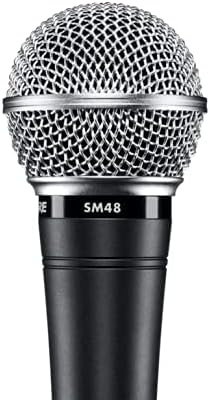
The first impression I got when I tested the SM48 was that it had a solid build. Even though it is less expensive than the SM58, it doesn’t in my experience appear to be a microphone designed as a cheap model.
When connected to a public address system the SM48 produced a clear sound with a focus on the midrange frequencies; the vocals were strong enough to be heard in the mix, although the treble wasn’t as smooth or detailed as that of the SM58. Yet for use in live performances it proved to be very effective.
When I moved it around a lot, the noise was noticeable, but for ordinary handheld use it wasn’t distracting. The built-in pop filter performed quite well in dealing with plosives.
In my opinion the SM48 is a dependable microphone for beginners and works well for use in rehearsals, for karaoke and at small performances.
Conclusion: Should you purchase the Shure SM48?
Then should the Shure SM48 be bought in 2025?
Yes, if you’re looking for an affordable and reliable vocal microphone, it does offer good performance at that price and retains the Shure name for durability.
The SM58 is not quite as refined and it wasn’t designed for use in studio recording. However, if you are looking for a microphone that will carry out the task without having to spend a lot of money, the SM48 is a good choice.
If you’re looking for a dependable microphone for karaoke, live rehearsals, speeches, or entry-level giIs the Shure SM48 suitable for use in singing?st cost-effective options on the market.
FAQ
Is the Shure SM48 good for singing?
Yes. While it doesn’t have the fullness of the SM58, it performs well for livOn the contrary, the SM58 has a softer and more refined sound as well as better durability; the SM48, however, is cheaper and is reliable. more refined sound and better durability. But the SM48 is cheaper and still reliable.
Does the SM48 require phantom power?
By no means is it a dynamic microphone, since it can be used with any standard XLR input.
Is the Shure SM48 good for podcasting?
It can be used for podcasting, though USB mics or higher-end dynamics (like the SM58 or SM7B) may be better choices.
Who should buy the SM48?
Beginners, schools, karaoke bars, churches, and anyone needing multiple budget-friendly mics.