


Your camera can produce beautiful video and still sound terrible. That’s because the microphones built into most cameras are designed mainly for convenience. They’re usually too far away from the person speaking, and they can easily capture wind, handling noise, echoes, and sounds coming from behind the camera.
Adding an external microphone is one of the easiest ways to improve your videos. But there isn’t one camera microphone that’s perfect for everyone.
A travel vlogger may want something tiny that doesn’t need batteries. A filmmaker may prefer a professional shotgun microphone. Someone recording interviews may get better results from a wireless system.
For most creators, the RØDE VideoMic NTG is one of the most versatile choices because it can handle traditional on-camera recording while offering features useful for more advanced video work.
What is the Best Camera Microphones?
Here are some of the best camera microphones to consider.
1. RØDE VideoMic NTG – Best Overall Camera Microphone
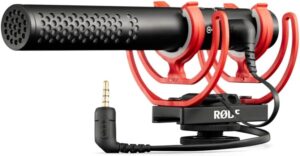
The RØDE VideoMic NTG is my overall recommendation for creators who want one microphone that can handle several different jobs.
It’s a directional shotgun microphone designed to sit on top of a camera and focus on the sound happening in front of it.
That makes it useful for vlogging, interviews, filmmaking, YouTube videos, and general run-and-gun recording.
What separates the VideoMic NTG from simpler camera microphones is the amount of control it gives you.
You get variable gain, high-pass filtering, a high-frequency boost, a safety channel, and other useful features for managing your audio before it reaches the camera. The microphone also has an internal rechargeable battery. Another big advantage is USB connectivity.
You aren’t limited to your camera. The VideoMic NTG can also work as a USB microphone with compatible computers and mobile devices.
That makes it particularly useful for creators.
You could use the microphone on your camera while filming, then connect it to your computer for a voiceover later.
2. RØDE VideoMicro II – Best Budget Camera Microphone
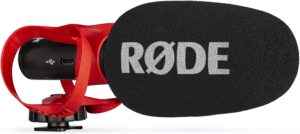
The VideoMicro II proves that improving your camera’s audio doesn’t have to involve a complicated setup. It’s tiny.
The microphone itself is only around 80 mm long, and the complete setup weighs just 39 grams. That’s particularly useful with compact mirrorless cameras.
Putting a large microphone on a tiny camera can make the entire setup feel top-heavy and awkward. The VideoMicro II adds very little bulk.
It uses a supercardioid pickup pattern designed to focus on sound in front of the microphone while reducing unwanted sound arriving from the sides and rear.
RØDE includes both foam and furry windshields along with cables for connecting to cameras and smartphones.
For a beginner looking for an affordable way to make camera audio noticeably better, this is one of the easiest recommendations.
3. Sennheiser MKE 400 – Best Compact Camera Microphone
The Sennheiser MKE 400 is another strong choice for vloggers and mobile filmmakers. It’s a compact directional microphone designed for use with cameras and smartphones.
You don’t necessarily want a giant shotgun microphone taking up more room in your bag.
The MKE 400 keeps things relatively compact while giving you more control than the simplest plug-and-play microphones.
It also includes features designed for real-world video production, such as wind protection and shock isolation.
That’s important because handling noise is a major problem with camera-mounted microphones.
Every time you touch the camera, adjust the lens, or move the tripod, vibrations can travel toward the microphone.
4. DJI Mic 3 – Best Wireless Camera Microphone
Sometimes the best camera microphone isn’t attached to the camera at all. If you’re filming someone standing several feet away, a camera-mounted shotgun microphone has a major disadvantage: distance.
A wireless microphone solves that problem by putting the microphone directly on the person speaking.
The DJI Mic 3 is a compact wireless system designed for this kind of work. You attach a small transmitter to the person you’re recording. Audio is transmitted wirelessly to a receiver connected to the camera.
The system supports advanced features including 32-bit float internal recording, giving professional creators a useful backup and additional flexibility when recording unpredictable audio levels.
It can also handle two-person interviews when using two transmitters.
For interviews, presentations, walking videos, and other situations where the subject moves around, wireless can produce much better results than leaving the microphone on the camera.
5. Audio-Technica AT875R – Best Budget XLR Shotgun Microphone
If you’re moving from casual video creation into more traditional filmmaking, consider the Audio-Technica AT875R. This is different from a typical consumer on-camera microphone. It uses a professional three-pin XLR connection and requires phantom power.
That means you’ll generally connect it to a compatible field recorder, mixer, audio interface, or professional camera rather than plugging it directly into a normal 3.5 mm camera input.
Why deal with the extra equipment? Because an XLR-based setup gives you more room to build a professional production audio system. The AT875R is also unusually compact. It weighs about 80 grams and measures only 175 mm long.
Audio-Technica gives it a line-and-gradient pickup design with a frequency response of 90 Hz to 20 kHz.
It’s an excellent entry point for filmmakers who want to start learning traditional boom and production-sound workflows.
6. RØDE VideoMicro II – Best Camera Microphone for Travel
The VideoMicro II deserves another recommendation because traveling changes what makes a microphone good. At home, an extra 200 grams doesn’t matter. When you’re carrying your entire production setup around a city for eight hours, every bit of weight starts to matter.
The VideoMicro II weighs only 39 grams and doesn’t require its own battery. That means there’s one less charger to pack and one less battery level to check before filming.
Its all-metal construction also makes it more appropriate for equipment that’s constantly going in and out of a camera bag.
RØDE includes a furry windshield too. That’s important for travel because you’ll probably spend a lot of time outdoors. Even a small amount of wind can overwhelm a camera microphone.
7. Professional Shotgun Microphones – Best for Serious Filmmaking
For professional film production, you may eventually outgrow microphones designed to sit on top of a camera. That’s normal. Professional dialogue is often recorded with an XLR shotgun microphone mounted on a boom pole.
The microphone is positioned just outside the camera frame and kept as close as possible to the actor. Models such as the RØDE NTG5 and Sennheiser MKH 416 belong in this category.
These setups cost more and require additional equipment, but they solve the biggest weakness of camera-mounted microphones: distance.
A professional microphone sitting ten feet away isn’t automatically going to sound better than a cheaper microphone sitting two feet away.
What Is an On-Camera Microphone?
An on-camera microphone attaches directly to your camera, usually through the cold shoe or hot shoe area. Most consumer models connect to the camera’s microphone input using a 3.5 mm cable.
Directional on-camera microphones are designed to focus more strongly on the area in front of the camera. That’s helpful for vlogging and run-and-gun video. But remember that directional doesn’t mean magical.
If the person speaking is 30 feet away, a camera-mounted microphone will still struggle.
Shotgun vs Wireless Camera Microphones
This decision depends mostly on how you shoot. A shotgun microphone mounted on your camera is incredibly convenient.
There’s nothing to attach to the person you’re filming, no wireless transmitter to hide, and no extra battery system to manage.
It’s excellent for spontaneous recording. Wireless microphones are better when your subject is far from the camera.
Imagine recording someone walking toward the camera while talking. With a camera-mounted microphone, the volume and room sound change as the person moves.
With a wireless microphone attached to their clothing, the distance between the mouth and microphone remains relatively consistent.
For interviews and presentations, wireless often wins. For general run-and-gun filming, an on-camera shotgun is simpler.
Final Thoughts
The best camera microphone depends less on your camera and more on what you’re filming. If you’re walking around making travel videos, you want something lightweight and easy.
If you’re recording interviews, getting the microphone close to the speaker matters more than keeping it attached to the camera.
If you’re making films, a proper shotgun microphone on a boom pole can be a much better investment.
For general content creation, the RØDE VideoMic NTG is my best overall camera microphone because of its combination of directional recording, onboard controls, camera connectivity, and USB functionality.
But don’t underestimate simpler microphones. The tiny VideoMicro II weighs only 39 grams, uses a supercardioid pickup pattern, requires no battery, and includes both foam and furry wind protection.