


AKG has been making microphones for decades, and some of its models have become studio classics. But choosing the best AKG microphone isn’t as simple as buying the most expensive one.
A singer recording vocals at home has different needs from someone recording a podcast. A live performer may want a rugged dynamic microphone, while a professional studio may need a sensitive condenser microphone with several polar patterns.
That’s why it’s important to think about what you’re actually recording.
For most home-studio users, the AKG P220 offers an excellent combination of sound quality, features, and value. If you have more to spend, the C214 is a serious upgrade. And for professional studio work, the C414 family remains one of AKG’s most capable choices.
What is the Best AKG Microphones?
Here are the best AKG microphones to consider in 2026.
1. AKG P220 – Best Overall AKG Microphone
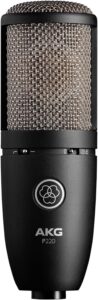
For most people building a home studio, I’d start with the AKG P220.
It’s a large-diaphragm condenser microphone designed for vocals, acoustic guitars, brass instruments, and general project-studio recording.
The P220 has a cardioid polar pattern. That means it primarily captures sound coming from the front while reducing sound arriving from behind.
Its frequency response runs from 20 Hz to 20 kHz, giving it enough range to handle vocals and many instruments.
AKG also includes a switchable bass-cut filter and a -20 dB attenuation pad. The pad is particularly useful when recording loud sources. With it engaged, AKG rates the P220 for sound pressure levels up to 155 dB SPL.
You also get a spider-style shock mount and metal carrying case.
For someone who wants one reasonably priced AKG condenser for vocals, instruments, YouTube narration, and other studio work, the P220 is an easy place to start.
Best for: Home studios, vocals, acoustic instruments, and general recording.
2. AKG C214 – Best AKG Microphone for Vocals
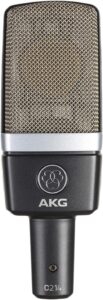
If you’re ready to move beyond an entry-level condenser, look at the AKG C214. The C214 was designed as a more affordable alternative to AKG’s famous C414 family.
It uses a one-inch capsule based on one side of the C414’s dual-capsule system. The result is a microphone aimed squarely at professional studio recording without the price or complexity of a full C414.
The C214 has a fixed cardioid polar pattern and a frequency response of 20 Hz to 20 kHz. Its equivalent noise level is rated at 13 dB-A, while sensitivity is 20 mV/Pa.
There’s also a switchable -20 dB pad. With the pad engaged, the C214 can handle sources up to 156 dB SPL.
That means this isn’t limited to quiet vocals. You can use it on loud instruments too. AKG also includes a bass-cut filter to help control low-frequency rumble and proximity effect.
For vocals, voiceovers, acoustic instruments, piano, and general studio recording, the C214 is one of my favorite AKG options.
Best for: Vocals, voiceovers, acoustic instruments, and serious home studios.
3. AKG C414 XLII – Best Premium AKG Microphone
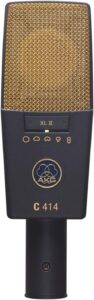
If budget isn’t your main concern, the C414 XLII is where things get much more interesting. This is a professional multi-pattern condenser microphone. Unlike the P220 and C214, you’re not locked into one cardioid pattern.
The C414 XLII provides nine selectable polar-pattern settings. That gives you much more control over how the microphone captures a room and its sound source.
You can use cardioid for a normal vocal recording. Omnidirectional can capture sound from around the microphone.
Figure-eight captures the front and rear while rejecting sound from the sides.
These options also make the C414 useful for advanced stereo recording techniques.
The C414 XLII has a 20 Hz to 20 kHz frequency range, selectable attenuation pads, and multiple bass-cut settings.
Its extremely low self-noise also makes it attractive for detailed studio recordings. This level of flexibility isn’t necessary for everyone.
If you’re recording one podcast at your desk, you’re probably paying for capabilities you won’t use.
But for a serious recording studio where one microphone may need to handle vocals, instruments, ensembles, drum overheads, and room recording, the C414 XLII is extremely versatile.
Best for: Professional studios and advanced recording.
4. AKG P420 – Best Multi-Pattern AKG Microphone for the Money
The P420 is an interesting middle ground. It’s considerably more affordable than a C414 but still gives you multiple polar patterns. You can choose between cardioid, omnidirectional, and figure-eight.
That makes the P420 much more flexible than a basic cardioid condenser. Suppose you’re recording one singer.
Use cardioid. Maybe you’re recording several people around the microphone. Omnidirectional becomes useful. Or perhaps you want to experiment with stereo recording techniques that require figure-eight.
The P420 gives you those options without moving into AKG’s premium price range. It has a 20 Hz to 20 kHz frequency response, 28 mV/Pa sensitivity, a -20 dB pad, and a bass-cut filter. AKG rates it for sound pressure levels up to 155 dB SPL.
For someone who wants to learn different microphone techniques in a home or project studio, the P420 offers a lot of flexibility.
Best for: Project studios, instruments, stereo recording, and people who need multiple polar patterns.
5. AKG D5 – Best AKG Dynamic Microphone
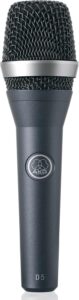
Not every recording situation calls for a condenser. Sometimes a dynamic microphone makes more sense.
The AKG D5 is designed primarily as a professional vocal microphone for live use. It has a supercardioid polar pattern.
This gives it a tighter pickup pattern than a typical cardioid microphone and helps provide strong feedback rejection on stage.
AKG also uses a dual shock-mount system to reduce mechanical noise. There’s an integrated pop filter and a rugged metal housing. The D5 has a frequency response of 70 Hz to 20 kHz. Unlike condenser microphones such as the P220, it doesn’t need phantom power to operate.
This makes it useful for live singers, rehearsal spaces, presentations, and situations where durability is more important than capturing every tiny detail in a quiet studio. It can also be useful for podcasting if you’re recording in a room that isn’t acoustically treated.
Best for: Live vocals, untreated rooms, and rugged everyday use.
6. AKG P120 – Best AKG Microphone for Beginners
You don’t need an expensive microphone to make your first recording. That’s where AKG’s P-series becomes attractive.
The P120 is aimed at project studios and people who need an affordable condenser microphone for getting started.
It’s the type of microphone I’d consider if you’re putting together your first XLR recording setup and need to keep the complete budget under control.
Remember that buying an XLR condenser involves more than buying the microphone. You’ll normally need an audio interface.
You’ll need an XLR cable. You’ll probably want a stand. And because condenser microphones generally require phantom power, your interface needs to provide it.
Once you’ve accounted for all those costs, saving money on the microphone can make sense.
The P120 gives beginners a straightforward entry into AKG’s studio microphone lineup without jumping immediately into C214 or C414 territory.
Best for: Beginners and budget home studios.
7. AKG C451 B – Best AKG Microphone for Acoustic Instruments
Large-diaphragm condensers get most of the attention because they’re commonly used for vocals. But they’re not the only type of condenser microphone worth owning.
The AKG C451 B is a small-diaphragm condenser designed for detailed instrument recording.
It’s particularly useful for sources such as acoustic guitar, percussion, cymbals, and drum overheads. Small-diaphragm condensers can respond very quickly to transients.
Think about the sharp initial attack when a drummer hits a cymbal or a guitarist plucks a string.
Capturing those details accurately is one reason microphones such as the C451 B are useful in recording studios.
I wouldn’t recommend it as the first microphone for someone who mainly records spoken podcasts. But for musicians building a microphone collection, it’s a very useful specialist tool.
Best for: Acoustic guitar, percussion, cymbals, and drum overheads.
Which AKG Microphone Is Best for Vocals?
I’d choose the AKG C214 for most serious vocal recording. It’s a professional large-diaphragm condenser without moving into the price range of the C414.
The cardioid pattern makes sense for a normal one-person vocal recording, while the -20 dB pad gives you enough flexibility to handle louder sources.
If you’re working with a smaller budget, choose the P220. For a professional studio where flexibility matters more than price, I’d move up to the C414 XLII.
Which AKG Microphone Is Best for Podcasting?
This depends heavily on your room. If you’re recording in a quiet, acoustically treated room, the P220 or C214 can produce detailed spoken-word recordings.
But condenser microphones are sensitive. That means they may also capture your room.
Keyboard clicks, computer fans, traffic, air conditioning, and reflections from bare walls can become more noticeable.
In an untreated room, a dynamic microphone such as the D5 may sometimes be easier to manage. For podcasting, don’t simply buy the microphone with the widest frequency response. Think about the room where you’re actually recording.
AKG P220 vs C214
These two microphones make sense for different budgets. The P220 is the value choice. You get a large-diaphragm cardioid condenser, 20 Hz to 20 kHz frequency response, bass-cut filter, -20 dB pad, shock mount, and carrying case.
That’s a strong package for a home studio. The C214 is the upgrade. It uses technology derived from the C414 family, has lower rated self-noise than the P220, and is positioned for professional studio applications.
If you’re making your first recordings, start with the P220.
If you’re serious about vocals and already have a decent recording environment, I’d spend more on the C214.
AKG C214 vs C414 XLII
The biggest difference is flexibility. The C214 is cardioid only. That’s perfectly fine for many vocal and instrument recordings.
The C414 XLII gives you nine selectable polar-pattern settings along with multiple pad and bass-cut options.
That makes the C414 much more useful in a professional studio where the microphone needs to do many different jobs.
But more features don’t automatically produce better vocals. If you only ever use cardioid, much of the C414’s flexibility may go unused. The C214 can therefore be the smarter purchase for a smaller studio.
Condenser vs Dynamic AKG Microphones
This is another important choice. Condenser microphones such as the P220, P420, C214, and C414 XLII are sensitive and can capture a lot of detail. That makes them excellent for studio vocals and instruments. But they’ll also reveal more of a bad room.
Dynamic microphones such as the D5 are generally better suited to loud sources, live performance, and situations where you want a simple, rugged microphone.
For a treated studio, I’d usually start with a condenser. For a noisy bedroom or live stage, I’d seriously consider dynamic.
Do AKG Condenser Microphones Need Phantom Power?
Most professional XLR condenser microphones require power to operate.
For models such as the P220, that power normally comes from your audio interface or mixer through the XLR cable. This is commonly called phantom power.
Look for a button marked 48V on your audio interface. Don’t confuse this with gain. Phantom power operates the microphone’s electronics. Gain amplifies the microphone signal.
They’re two different things.
Do You Need an Audio Interface?
For the XLR microphones discussed here, yes, in a typical computer recording setup. The microphone connects to the interface using an XLR cable.
The interface converts the analog microphone signal into digital audio your computer can record. A basic setup looks like this:
AKG microphone → XLR cable → audio interface → computer
If you’re using a condenser microphone, make sure your interface can provide the appropriate phantom power.
Which AKG Microphone Should You Buy?
For most home studios, my overall recommendation is the AKG P220. It gives you a useful combination of sound quality, durable construction, a bass-cut filter, attenuation pad, shock mount, and carrying case without requiring a professional-studio budget.
If vocals are your priority and you can spend more, choose the C214. If you want multiple polar patterns without paying C414 prices, look at the P420.
For live vocals or a less-than-perfect recording room, consider the D5. And if you’re building a professional studio and want maximum versatility, the C414 XLII is the standout.
Final Thoughts
The best AKG microphone isn’t necessarily the most expensive one. It’s the microphone that matches what you’re recording. A beginner recording vocals in a bedroom probably doesn’t need a C414 XLII.
A professional engineer who records everything from singers and pianos to ensembles and drum overheads may quickly outgrow a simple entry-level cardioid microphone. That’s why I’d start with your actual use case.
For most people, the AKG P220 is the best overall starting point. It handles vocals and instruments, has useful onboard controls, and comes with practical accessories.
The C214 is the model I’d move toward when vocal recording becomes more serious.
And the C414 XLII is where I’d look when versatility and professional studio performance matter more than price. Buy the microphone for the recordings you’re making now. You can always add another microphone when your studio—and your needs—grow.