


A large diaphragm condenser microphone is one of the first serious upgrades many people make when building a recording studio. There’s a good reason for that.
These microphones are incredibly versatile. You can use one to record vocals, acoustic guitar, piano, voiceovers, podcasts, strings, percussion, and even guitar amplifiers. Their sensitive condenser capsules can capture small details that may be harder to hear with a typical handheld dynamic microphone.
But there are dozens of options. Some cost around $100. Others cost thousands. You don’t necessarily need the most expensive microphone. The right choice depends on your voice, room, instruments, audio interface, and budget.
For most home studios, the RØDE NT1 is an excellent place to start. The Audio-Technica AT4040 is a great step-up option, while the Neumann TLM 103 is one of my favorite premium choices for vocals and professional recording.
What is the Best Large Diaphragm Condenser Microphones?
Here are eight of the best large diaphragm condenser microphones to consider.
1.RØDE NT1– Best Large Diaphragm Condenser Microphone Overall
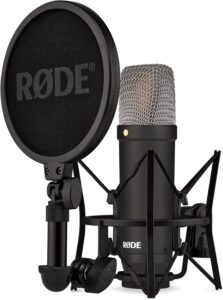
The RØDE NT1 has been a popular studio microphone for years. Its biggest strength is versatility.
You can put it in front of a singer, acoustic guitar, amplifier, or other instrument and get a clean recording without needing an extremely expensive microphone collection.
The current NT1 5th Generation is particularly interesting because it combines traditional XLR connectivity with USB.
That means beginners can connect it directly to a compatible computer over USB without buying a separate audio interface. As your studio grows, you can switch to XLR and use it with a traditional microphone preamp or interface.
The NT1 is also known for extremely low self-noise, which makes it useful for quieter sources.
For someone buying their first serious condenser microphone, the combination of sound quality, flexibility, and relatively accessible pricing makes the NT1 difficult to ignore.
2. Audio-Technica AT4040 – Best Midrange Large Diaphragm Condenser Microphone
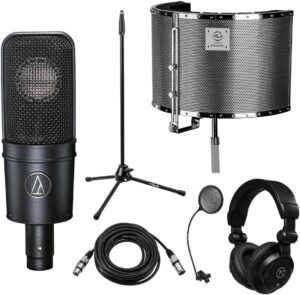
The Audio-Technica AT4040 is one of those microphones that can remain useful even as the rest of your studio becomes more expensive. It uses an externally polarized condenser design with a cardioid pickup pattern.
Audio-Technica specifies a 20 Hz to 20 kHz frequency response and only 12 dB SPL of self-noise.
The microphone can also handle 145 dB SPL normally or 155 dB SPL when you engage its 10 dB pad. That’s a lot of headroom.
You can use the AT4040 for delicate vocals and acoustic instruments, but it can also handle much louder sources.
There’s an 80 Hz high-pass filter for controlling low-frequency rumble and a switchable 10 dB pad. This combination makes the AT4040 particularly versatile.
If you’ve outgrown an entry-level condenser and want one microphone that can handle a wide range of studio jobs, this is an excellent step up.
3. Neumann TLM 103 – Best Premium Large Diaphragm Condenser Microphone
Neumann is one of the most famous names in studio microphones. The TLM 103 is one of the company’s more accessible large diaphragm models, although it’s still significantly more expensive than typical home-studio microphones.
It uses a large diaphragm capsule derived from the capsule design associated with the legendary Neumann U 87.
The TLM 103 has a cardioid pickup pattern and a 20 Hz to 20 kHz frequency range.
One of its most impressive specifications is self-noise. Neumann rates it at only 7 dB-A. That’s extremely quiet and makes the microphone suitable for capturing subtle sources.
It also has a broad presence boost above roughly 5 kHz, helping vocals and solo instruments sound clear and forward.
The TLM 103 can handle up to 138 dB SPL and provides a 131 dB dynamic range. It doesn’t offer multiple polar patterns, pads, or filters. Instead, Neumann keeps the design simple.
If you primarily want a premium microphone for vocals, voiceovers, instruments, and professional studio work, the TLM 103 is a strong choice.
4. AKG C414 XLS – Best Versatile Large Diaphragm Condenser Microphone
If versatility matters more than simplicity, look at the AKG C414 XLS. This is the kind of microphone you can buy once and continue finding new uses for years. The biggest advantage is its selectable polar patterns.
Instead of being limited to cardioid, you can choose between multiple pickup configurations, including cardioid, omnidirectional, figure-eight, hypercardioid, and wide cardioid settings.
AKG provides nine selectable polar patterns in total. That opens up many recording techniques. Use cardioid for vocals. Use omnidirectional to capture more of a good-sounding room. Use figure-eight for certain stereo recording techniques.
The C414 XLS also includes three attenuation settings of -6, -12, and -18 dB, along with selectable bass-cut filters. Self-noise is rated at only 6 dB-A.
If you’re building a professional studio and want one large diaphragm condenser that can handle an enormous variety of recording situations, the C414 XLS deserves serious consideration.
5. Audio-Technica AT2020 – Best Budget Large Diaphragm-Style Studio Condenser
The Audio-Technica AT2020 has become one of the most recognizable entry-level studio microphones.
It’s popular because it gives beginners a straightforward way to start recording with an XLR condenser microphone without spending hundreds of dollars.
The AT2020 uses a cardioid pickup pattern. This makes it easy to understand. Point the front toward your voice or instrument and position the rear toward sounds you want to reduce.
It’s particularly useful for vocals, voiceovers, acoustic instruments, and beginner home studios. However, don’t expect it to provide every feature found on more expensive microphones.
There are no multiple polar patterns or extensive onboard controls. That’s fine for beginners.
If you’re buying your first audio interface and microphone at the same time, keeping the microphone affordable gives you more money for headphones, a stand, pop filter, cables, and basic acoustic treatment.
6. Neumann TLM 102 – Best Compact Premium Condenser Microphone
The TLM 102 is another interesting Neumann option. It’s smaller and generally more affordable than the TLM 103 while still giving you a genuine Neumann studio microphone.
The compact design makes it particularly attractive for smaller studios where a huge microphone and shock mount can block your view.
Like the TLM 103, it’s primarily designed around straightforward cardioid recording. The TLM 102 is especially appealing for vocals. It can also work well on acoustic instruments, percussion, and amplifiers.
For someone moving from a budget condenser into premium studio equipment, the TLM 102 can provide a more attainable entry into Neumann’s microphone lineup.
I would consider it if you want a premium vocal microphone but aren’t ready to move into the price range of the TLM 103 or U 87.
7. Lewitt LCT 440 PURE – Best for Modern Vocal Recording
Lewitt has become a popular microphone brand among home-studio owners and modern producers. The LCT 440 PURE is designed around a relatively straightforward cardioid condenser format.
Instead of filling the microphone with complicated switches, Lewitt focuses on delivering a clean studio recording. This makes it particularly attractive for singers, rappers, voiceover artists, and content creators.
The microphone can also handle high sound-pressure levels, allowing it to work on more than quiet vocals.
Use it for acoustic instruments, percussion, and amplifiers too. For modern home studios, the LCT 440 PURE sits in an attractive position.
It’s a meaningful upgrade over many entry-level condensers without immediately jumping into premium Neumann pricing.
8. AKG C214 – Best Affordable Alternative to the C414
The AKG C414 is fantastic, but not everyone needs all those polar patterns and controls. The AKG C214 offers a simpler alternative. It’s a cardioid condenser microphone aimed at people who want a professional studio microphone without paying for the C414’s complete feature set.
The fixed cardioid pattern is perfectly adequate for many recording situations. Most solo vocal recordings are made using cardioid anyway.
The C214 is useful for vocals, acoustic guitar, guitar amplifiers, percussion, and other instruments. It also includes useful features such as attenuation and bass-cut controls.
If you like the idea of an AKG studio condenser but don’t need nine polar patterns, the C214 may provide better value.
Final Thoughts
For most home studios, start with the RØDE NT1 or Audio-Technica AT4040. The NT1 is particularly attractive for beginners, while the AT4040 gives you useful professional features such as an 80 Hz roll-off and 10 dB pad.
For premium vocals, choose the Neumann TLM 103. Its 7 dB-A self-noise, 23 mV/Pa sensitivity, 138 dB maximum SPL, and presence-focused voicing make it particularly well suited to detailed vocals and solo instruments.
For maximum studio flexibility, choose the AKG C414 XLS. Its nine polar patterns, three attenuation settings, and three bass-cut filters allow it to handle an enormous range of recording situations.
And if you’re just starting out, don’t underestimate an affordable microphone.
A modest condenser in a good room with proper microphone placement can produce a better recording than a $2,000 microphone used badly.